

In the following article, only woods that are cultivated and ultimately harvested in accordance with strict sustainability rules are described and showcased.
The main type of wood for barrel making is – and this is probably well known to the general public – oak. Various grades of the species are used in different ways. However, traditions from other countries, based on special distillates such as slivovic (mulberry (Morus), robinia or oak) or some wines (robinia), also arouse curiosity as to how types of wood other than oak affect the various products during maturation. The sweet chestnut already played a role in wine production in Roman times.
But now, one by one and variety by variety.
Let’s start our excursion with the supposedly well-known species: the oak, whose botanical name is “Quercus”. As described at the beginning, we distinguish between different varieties with different characteristics depending on the growing region:

American oak
American oak (Quercus Alba) differs from European oak in a number of respects. The most central point is the density of the wood. The American white oak has a greater ring density than the European sessile oak. This leads to a greater exchange of oxygen in the barrel, which increases the influence of the wood on the product. The majority of American white oak comes from the Midwest of the USA, Missouri and the Ozark Mountains. American oak is used to make bourbon barrels with a capacity of 190 liters, the so-called ASB (American Standard Barrel), as well as barrique barrels. The heat treatment of the barrel can be adjusted to produce a wide variety of aromas. Toasting is a thermal treatment of the wood that produces vanilla aromas, among other things. These vanilla aromas are much more pronounced in American oak than in its European sister. American white oak contains up to ten times more vanillin. By adapting the toasting, a wide variety of aromas such as dark chocolate, ripe fruit or sweet caramel can be produced.
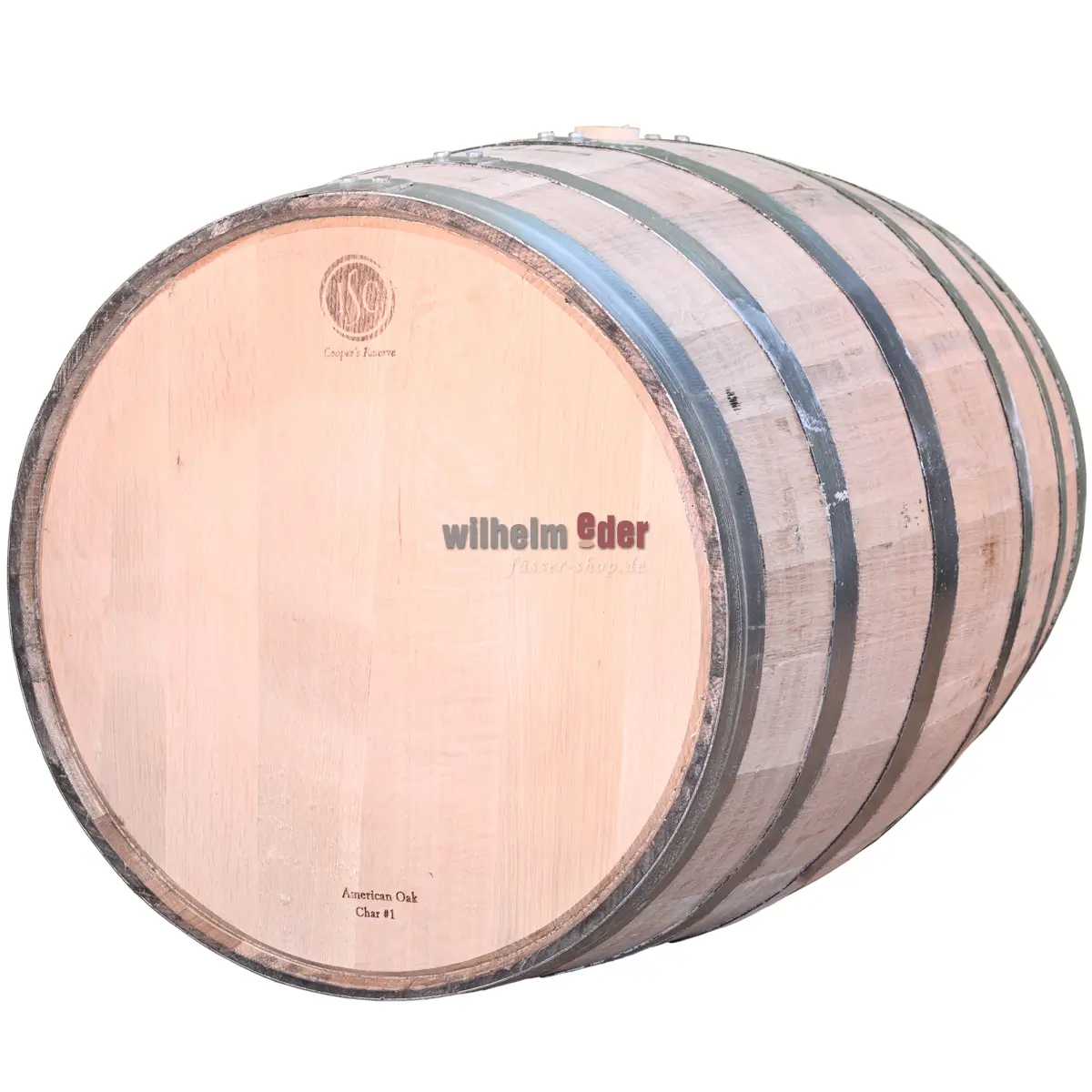
Original whisky barrel, made of 18-month air-dried American Oak by Independent Stave Company (ISC - World Cooperage) in the USA – hewed in Ozars / Missouri.These barrels have been toasted with the classic gas toast charring.In the standard segment, these barrels are equipped with Char 1, Char 3 or the "Alligator" Toast (Char 4), which is a very dark char, designed to provide more extractives for the spirit while offering a unique flavor profile, which tastes like bourbon vanilla, toast or nuts together with sweet smoke aromas. The color release is excellent, leading to a dark gold color.These barrels have been toasted with the classic gas toast charring.In the standard segment, these barrels are equipped with Char 1, Char 3 or the "Alligator" Toast (Char 4), which is a very dark char, designed to provide more extractives for the spirit while offering a unique flavor profile, which tastes like bourbon vanilla, toast or nuts together with sweet smoke aromas. The color release is excellent, leading to a dark gold color.Due to the charring and the thin stave thickness (20 mm), your distillate matures quickly.Charred heads. Bung made of wood Toast:- Char 1- Char 3- "Alligator" Toast (Char 4) Char levels—Or how long the barrel’s interior is exposed to intense heatLevel 1 Char—15 secondsLevel 2 Char—30 secondsLevel 3 Char—35 seconds (this is the most common charring)Level 4 Char—55 seconds (this is also referred to as “alligator char,” as it produces a wood texture similar to an alligator’s hide)
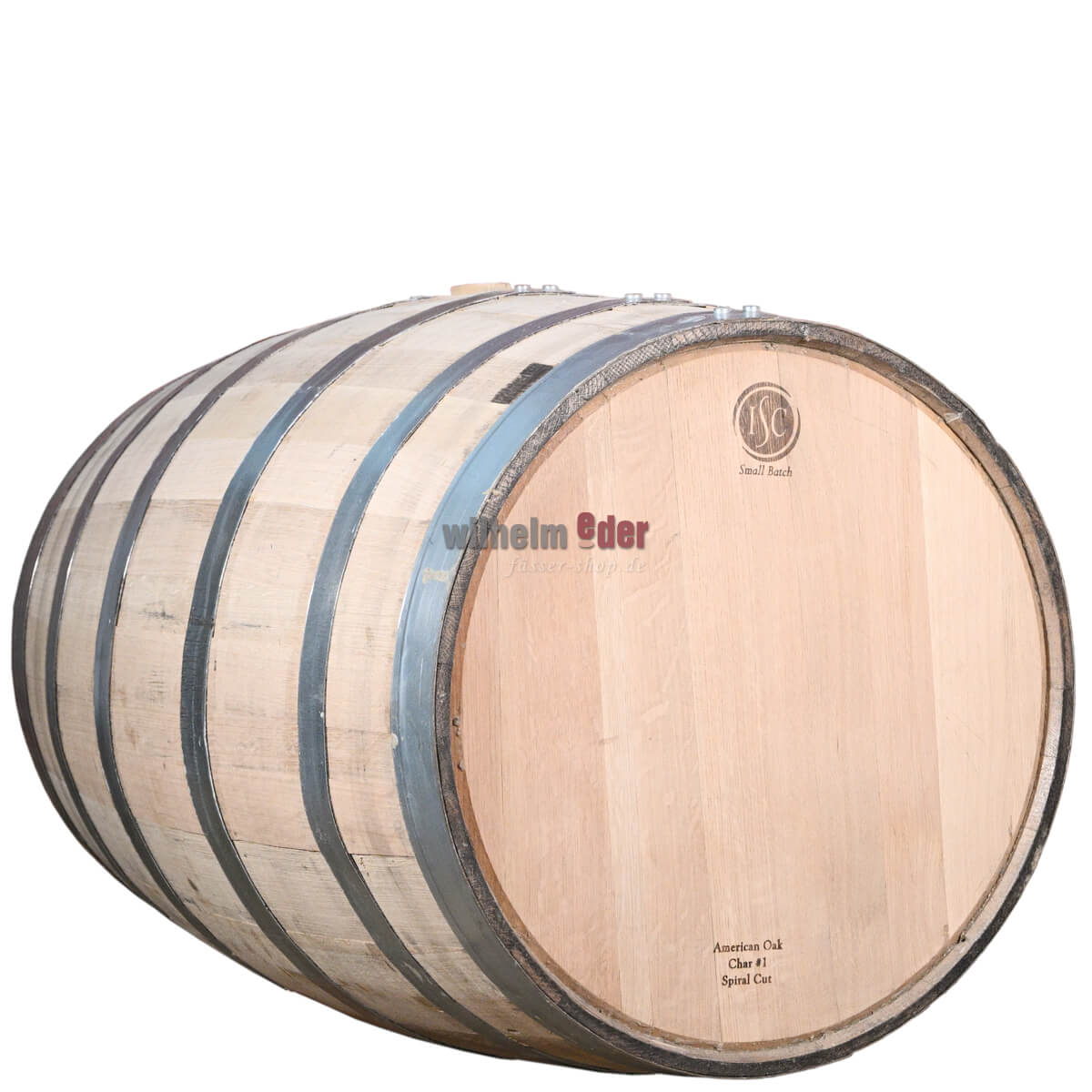
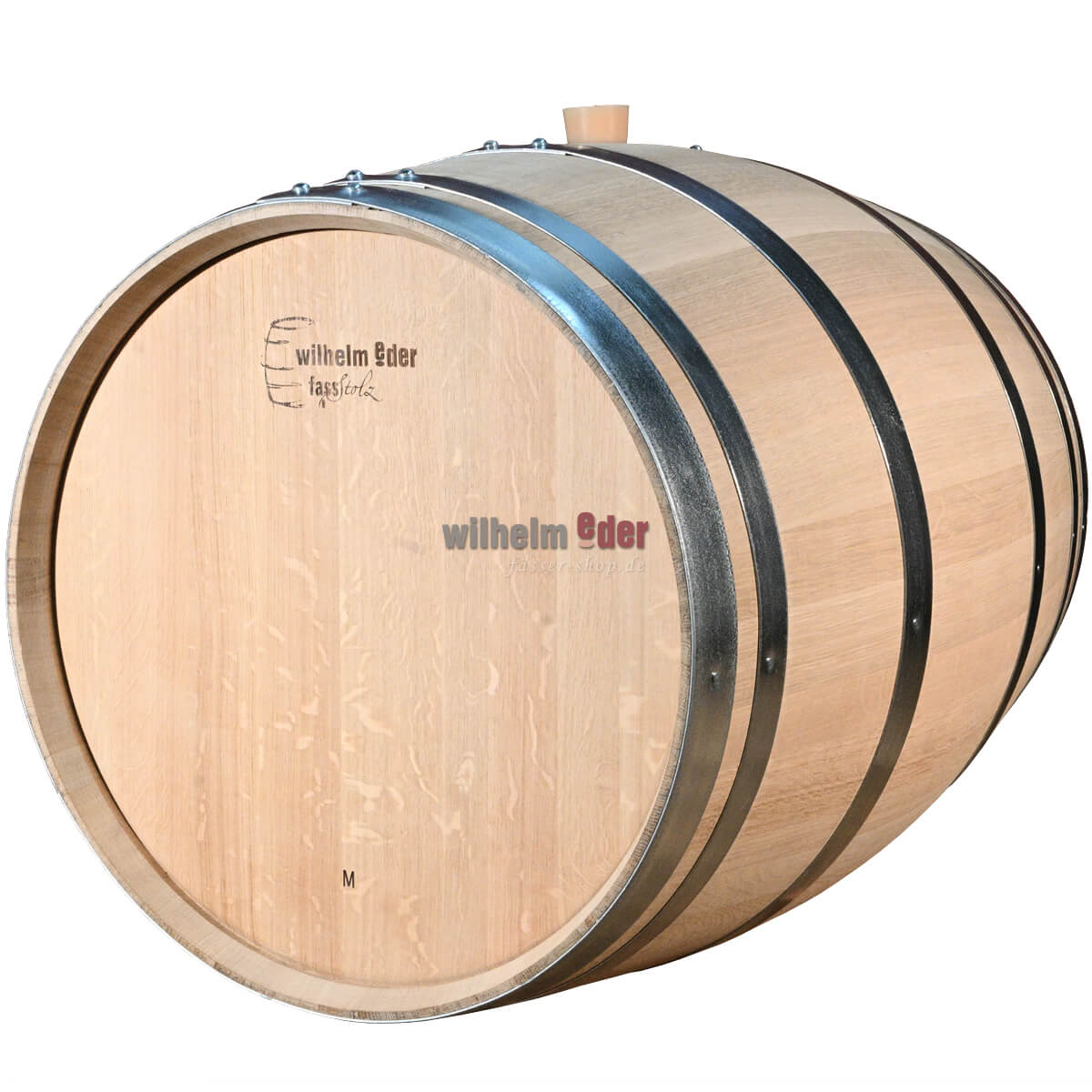
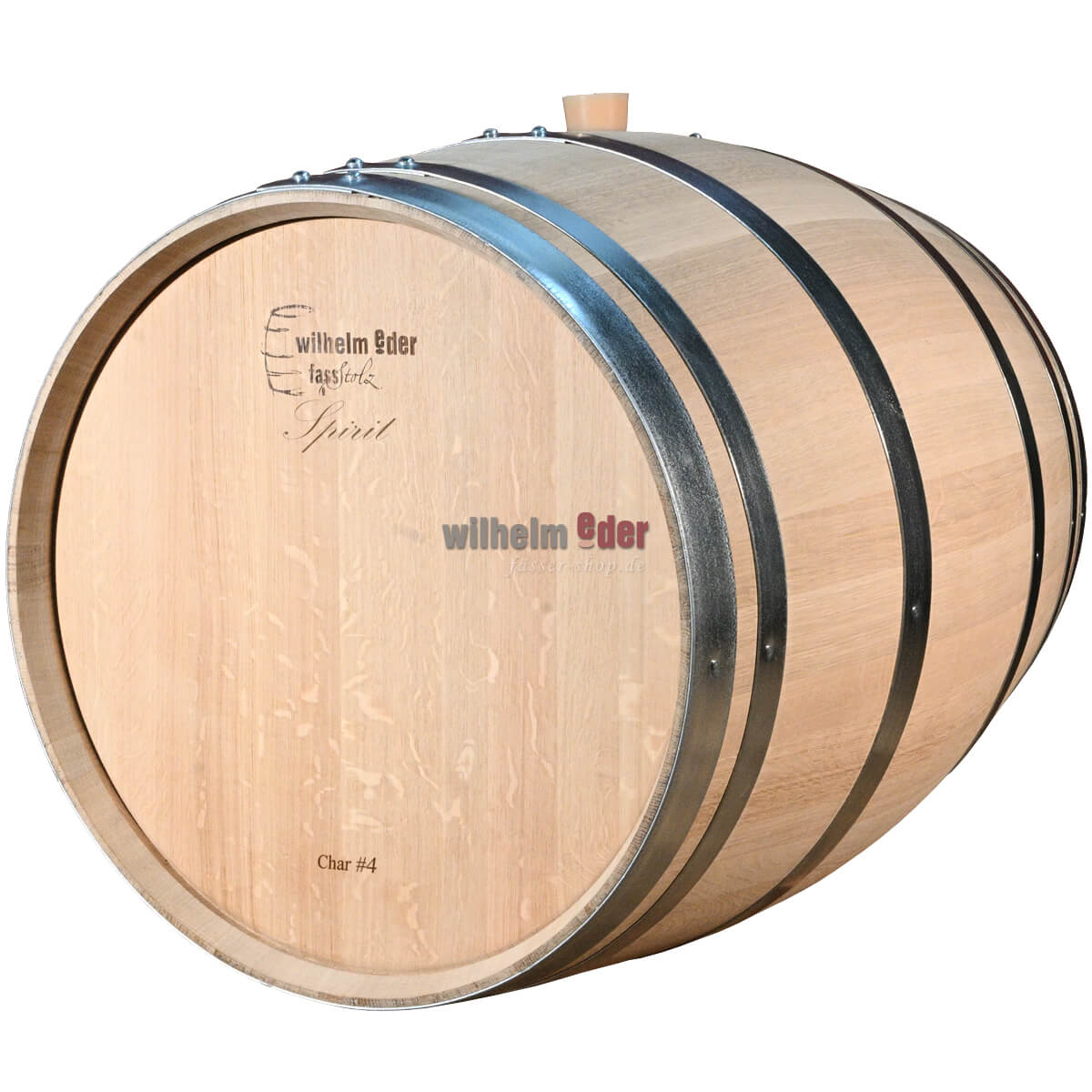
This barrel is toasted Medium Plus and has been charred afterwards with Char #1 or #4. The difference between the different char levels is the depth to which the charring is burned into the wood. These different depths can be achieved by using a longer or shorter Charring. The carbon layer is thinnest at Char 1 (flash char) and deepest at Char 4 (aligator char). Thanks to a spiral milling in the surface of the barrel has been increased. The remaining chips have been left in the barrel. The chips are a part of the barrel thus it’s no aromatization and is allowed. This combination offers more flavors in less time. Producer: Independant Stave company (ISC)
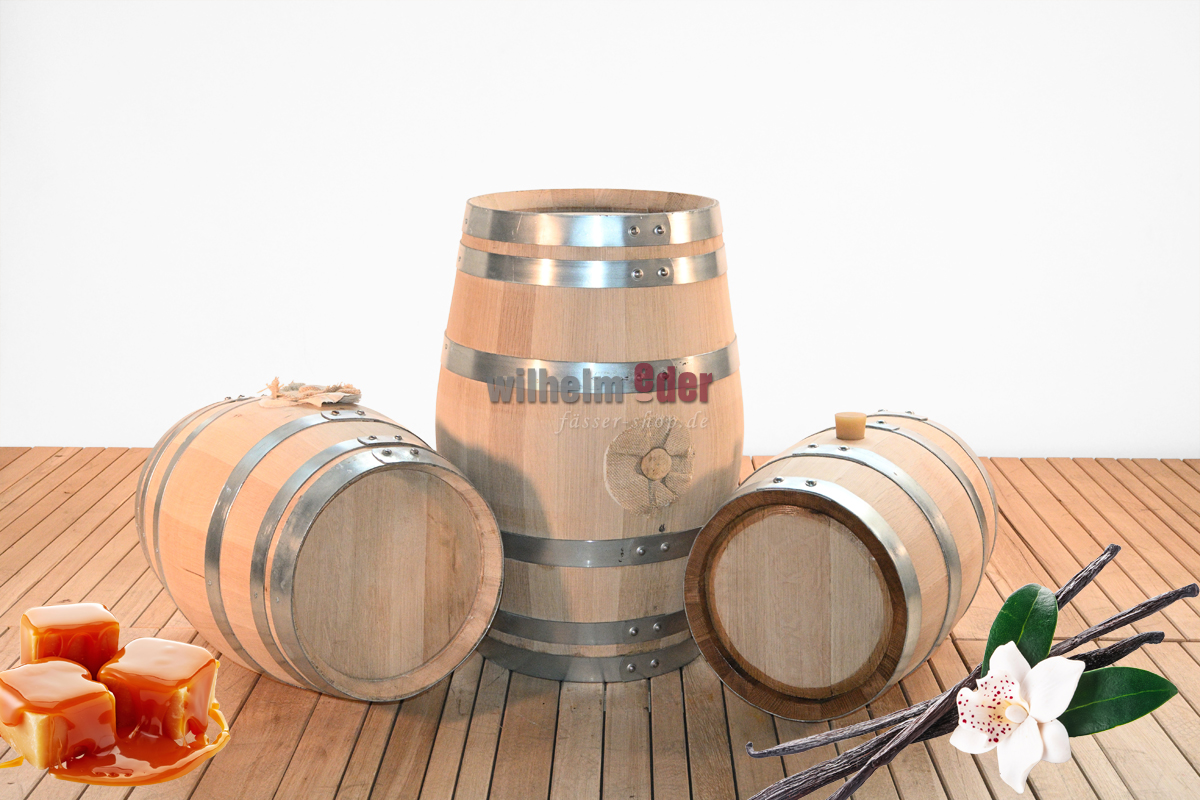
Distillate barrels 100 l - made from American White Oak. The barrel interior is toasted/charred and the exterior of the barrel is raw. They are perfect for your beer distillate, whisky, corn and other distillates which need a fine vanilla note with roasted aroma during maturation.Available toastings:MediumMedium PlusChar 3 Please note, the content indicated for wooden casks do not correspond with net capacity. The capacity can be higher or even less. Balances are not reason for reclamations. Supplied without barrel storage or racks. Delivery without spigot.Please note that the oak wood will release its aromas to the beverage stored in the barrel after a short time. If you do not want any change in the taste, we recommend ornamental barrels or barrels with inner stainless steel bubble.
Distillate barrels 30 l – ca. 50 l - made from American White Oak. The barrel interior is toasted/charred and the exterior of the barrel is raw. They are perfect for your beer distillate, whisky, corn and other distillates which need a fine vanilla note with roasted aroma during maturation. Toast: Heavy Please note, the content indicated for wooden casks do not correspond with net capacity. The capacity can be higher or even less. Balances are not reason for reclamations. Supplied without barrel storage or racks. Delivery without spigot.Please note that the oak wood will release its aromas to the beverage stored in the barrel after a short time. If you do not want any change in the taste, we recommend ornamental barrels or barrels with inner stainless steel bubble.
A hybrid barrel made of American and German oak. The German oak was used for the staves and the American oak for the heads.The barrel was crafted for the producer who wants softer oak flavors with increased complexity after extended aging. Heavy Toast with a light Char finish The barrel has been toasted slowly over an oak fire for 30 minutes before it catches on fire to create the light char level on the surface. Longer aging is required for this toast to maximize flavor and complexity. The barrel is equipped with a silicone bung as standard. Supplied without barrel storage or racks. Please note, the content indicated for wooden casks do not correspond with net capacity. The capacity can be higher or even less. Balances are not reason for reclamations.
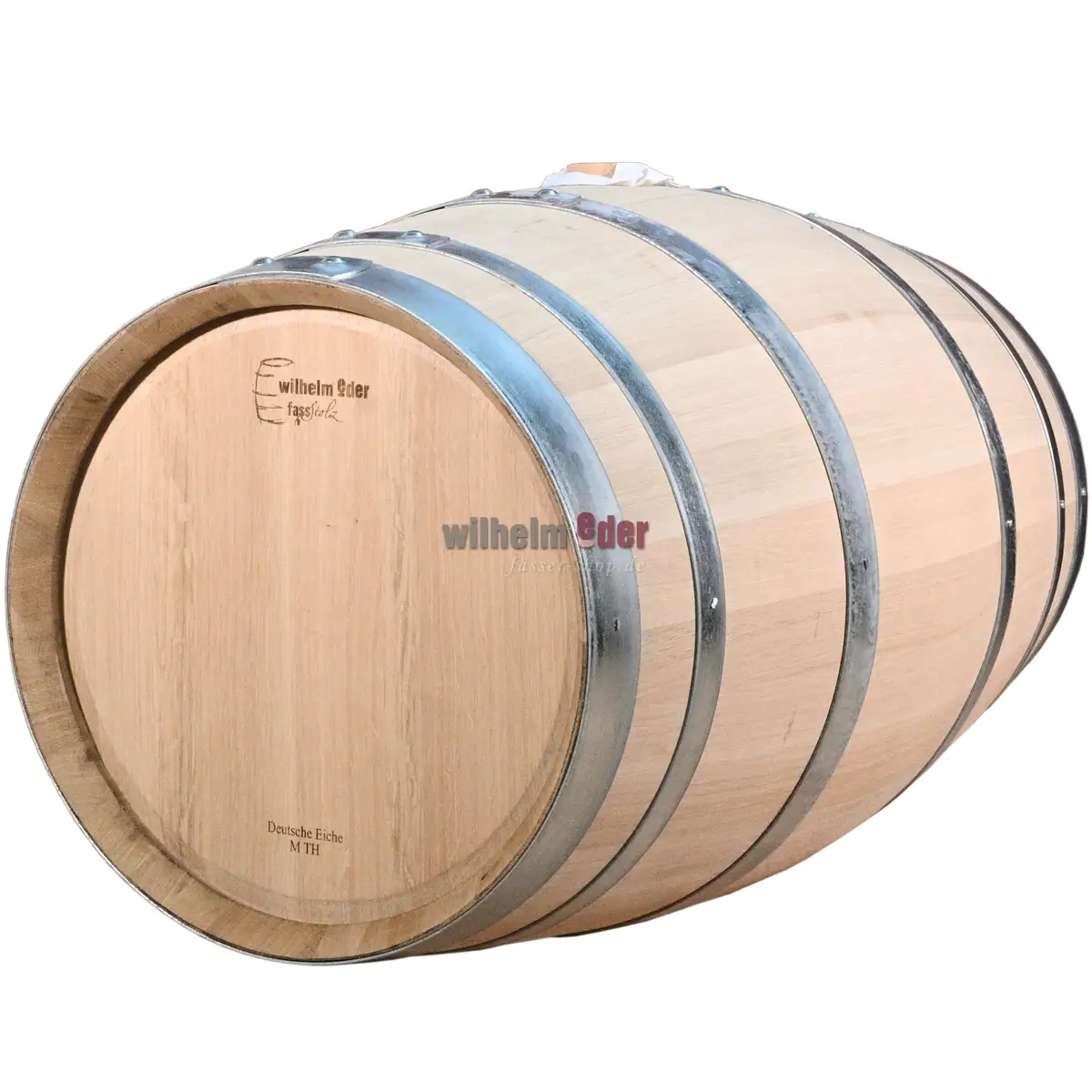
These barrels were built in the characteristic cigar shape to achieve a faster and more effective maturing. The barrels are available in German (brings spice and emphasizes the fruit) or American oak (brings vanilla and increases the mouthfeel). Due to the elongated design with the same volume, the inner surface is larger than that of a 110 l barrel of the classic design. This larger surface serves both for micro-oxygenation and the release of wood aromas. Several tests and tastings have shown a more balanced, harmonious result. Due to their design, the relatively small barrel heads are, like the staves of the barrel, also treated with medium toast (Fine tannic structures, toasted bread, vanilla, light caramel). The barrel is equipped with a silicone bung as standard. Our toastings are applied very slowly, you can see it in the uniformity inside the barrel and without burn bubbles on the stave! Please note, the content indicated for wooden casks do not correspond with net capacity. The capacity can be higher or even less.Balances are not reason for reclamations.
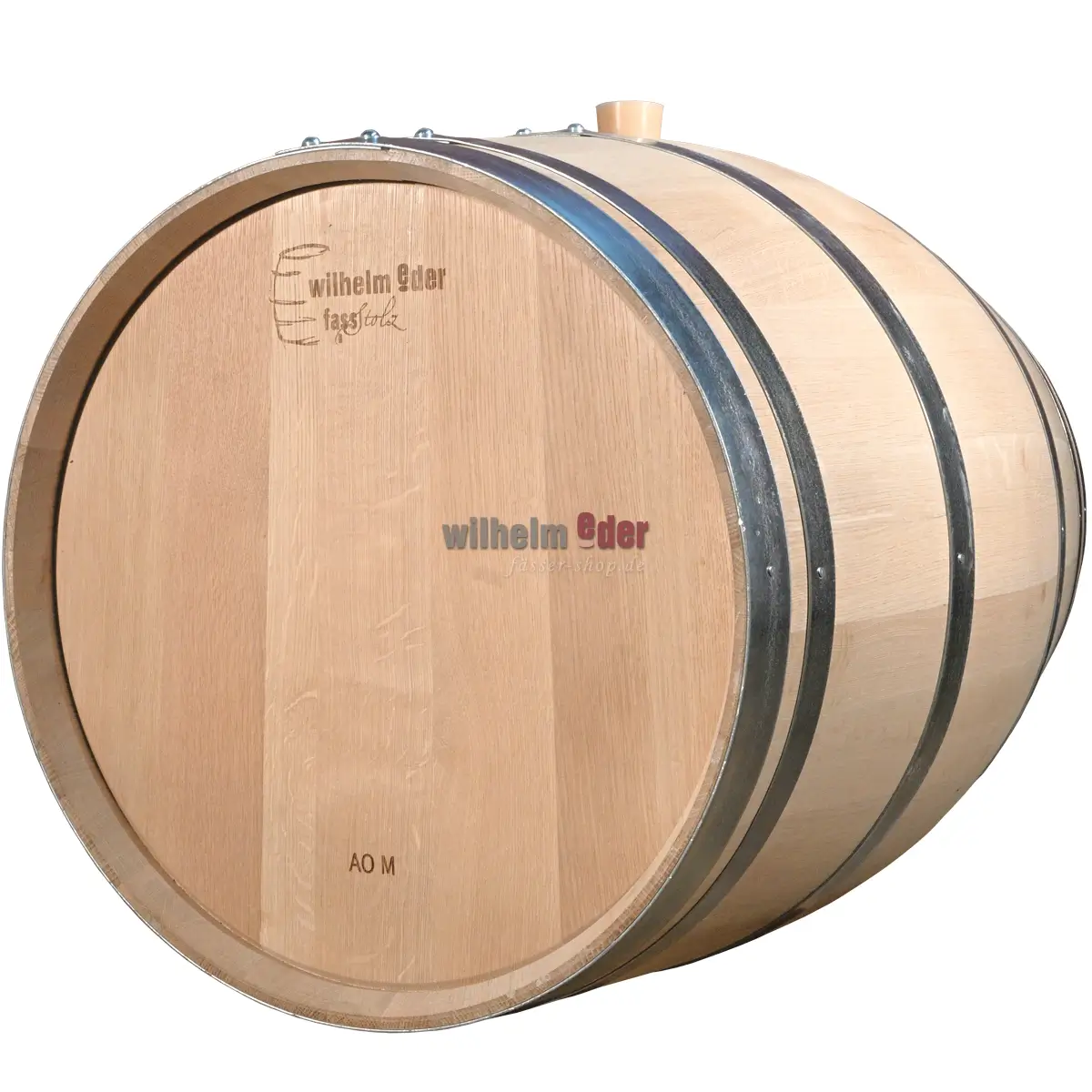
These barrels made from American white oak from German production are not only particularly attractive due to their soft and vanilla-like sensory characteristics, but also due to their optimized cost structures. Toastings:MediumMedium PlusChar 3Medium Plus + Char 3 (Double Toast)Forte Toast Toasted heads, with silicon bung
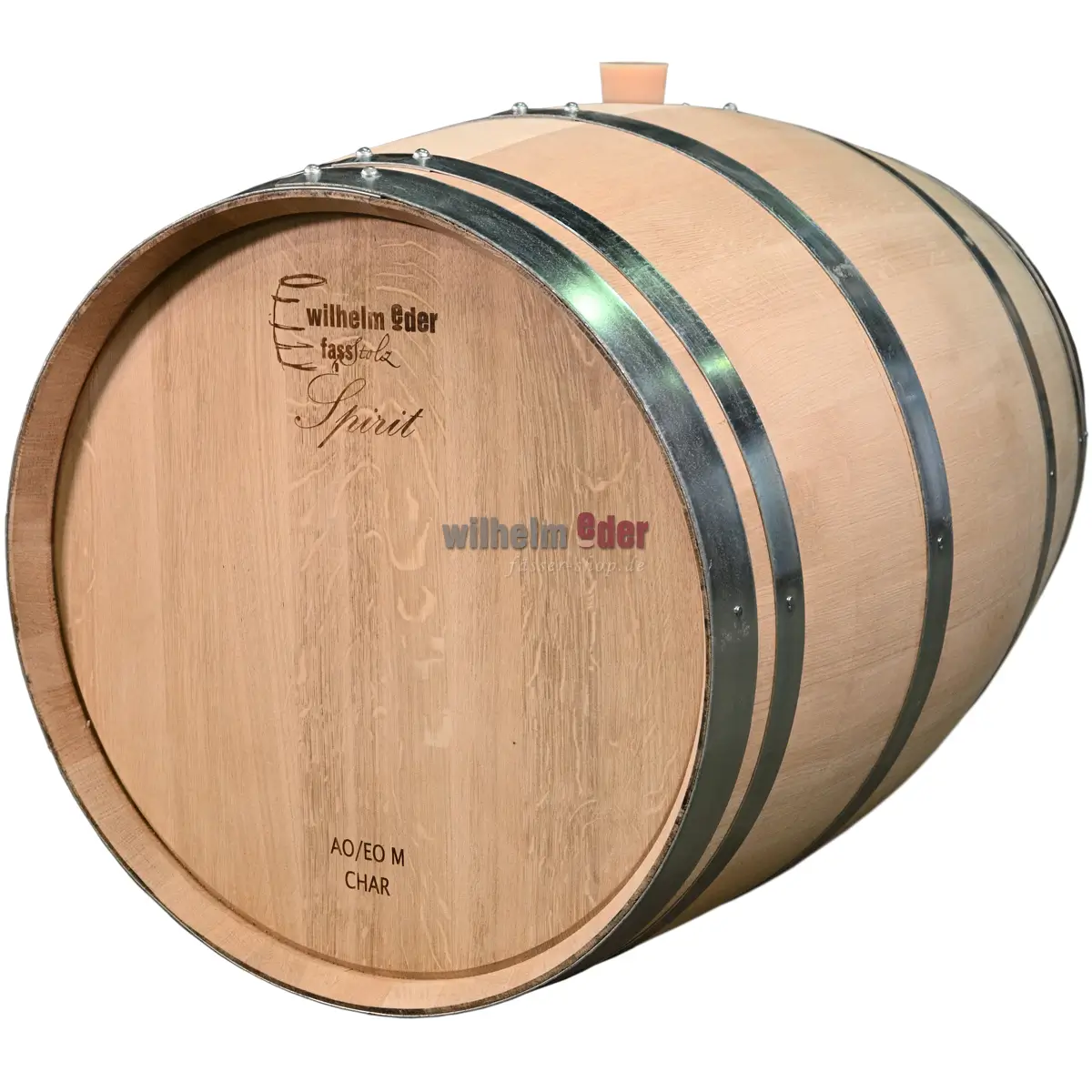
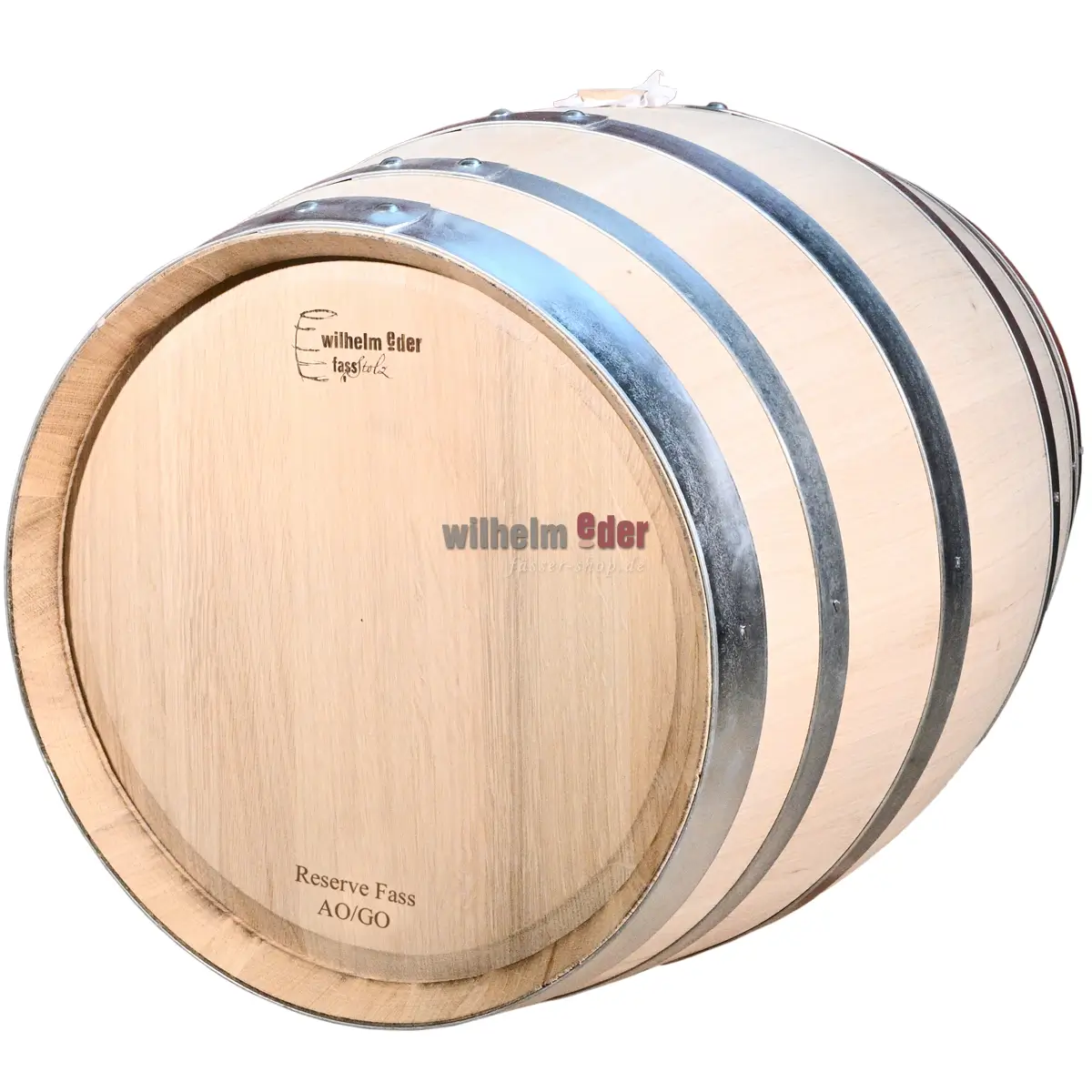
The staves of this hybrid barrel were made from American oak and the heads from European oak. The barrel was developed for users in the distillate sector who want to achieve a softer oak influence with greater complexity after longer maturation.Char 1 or Char 4 with charred headsThe reserve barrel is slowly toasted over an oak fire for 30 minutes. It then catches fire to create a slight char level on the surface. With this toast, the distillate must be left in the barrel for longer to maximize aroma development and complexity.Galvanized hoops - toasted headsPlease note that the nominal size of wooden barrels does not always correspond to the net capacity, which may be higher or lower. Deviations do not constitute grounds for complaint.
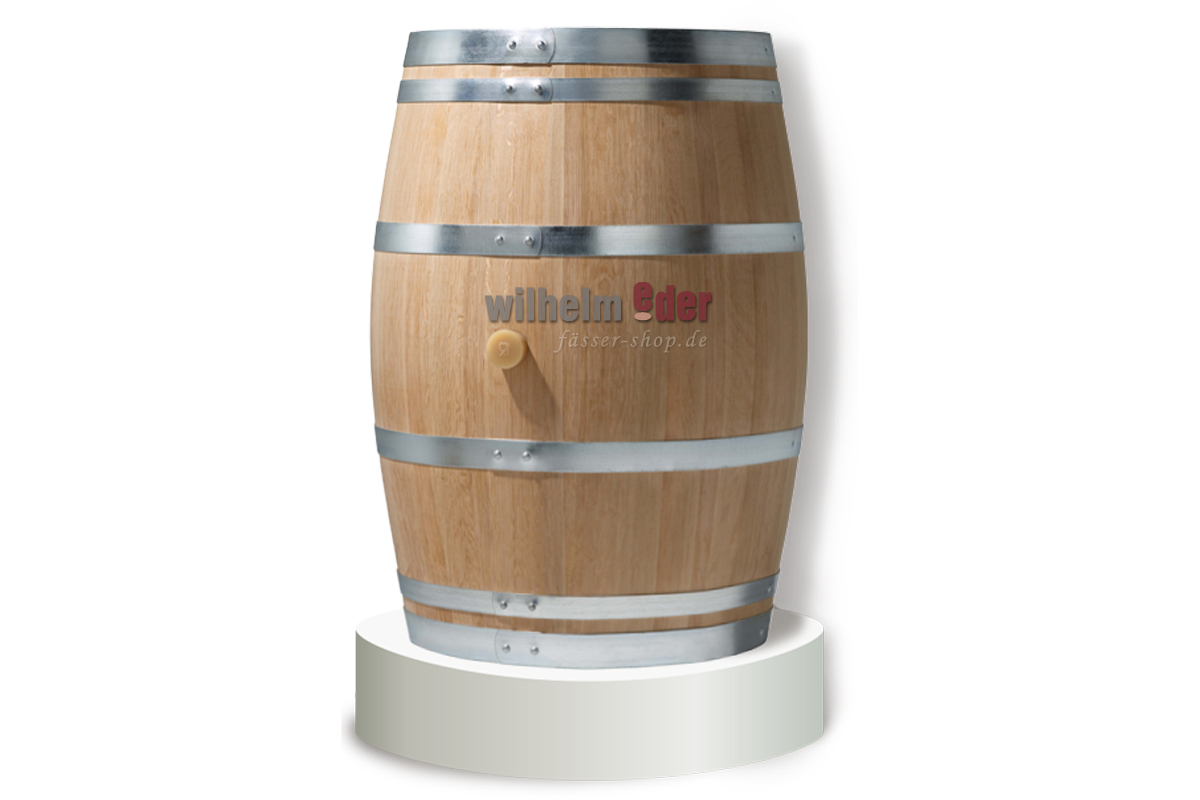
Barrel staves stored for 24 monthsBarrel hoops: 6 hot-dip galvanised tyresWood origin: USA (Arkansas, Kansas, Missouri, Oklahoma)Toasting technique: Traditional with toasted headsAromas: rich oak wood and roasted aromas, vanilla, spices, brown sugarPalate: balance between fruit and roasted aromas, rich in structure and with a fine finishPerfect for: strong red and white wines such as Cabernet Sauvignon, Chardonnay, Merlot, SyrahWe recommend a maturation period of: 12-18 monthsWe have put together a selection of these toastings for you with brief information:These profiles represent a selection of very popular toasting variants in Europe. Many of these used alone are too much for one wine, therefore the combination must be sought and selected. The application to other types of wine is also conceivable! For further toasting profiles please contact us!Profiles 11:This toasting is designed for really fine wines, it adds body and length while creating a nice balance between fruit and wood. This toasting on the classic American barrel brings complexity and finesse! Can be used for example with Merlot, Cabernet Sauvignon, Sauvignon Blanc, Chardonnay.Profile 33:Developed by a European oenologist, designed for medium to very complex body red wines. This toast is applied in a relatively short time with great heat. Characteristic are vanilla aromas, light toasted characters, slightly wood characters on the tongue. To be applied e.g. with Cabernet Sauvignon and Syrah.Profile 37:A toast made by slowly and steadily applying heat. This toast enhances the toasted aromas, it brings a mix between dark toast, toffee and caramelized sugar. This toast gives the wine a typical barrique taste. To be used for example with Merlot, Cabernet Sauvignon, Sauvignon Blanc, Chardonnay.Profile 52:A toasting developed to reduce the lactone character in American oak. By increasing the toasting time and temperature, the lignin breakdown is increased and this profile pronounces vanilla notes. It is a toasting that offers the fruity character and light notes of dark toast and smoke aromas.Profile 105:Corresponds to the Medium Plus Toasting and is a further development of this, with a somewhat rounder finish.Profile 107:This toast is an intermediate between Profile 52 and Profile 33, it offers mild vanillin and roasted aromas, has its best results in Pinot Noir.
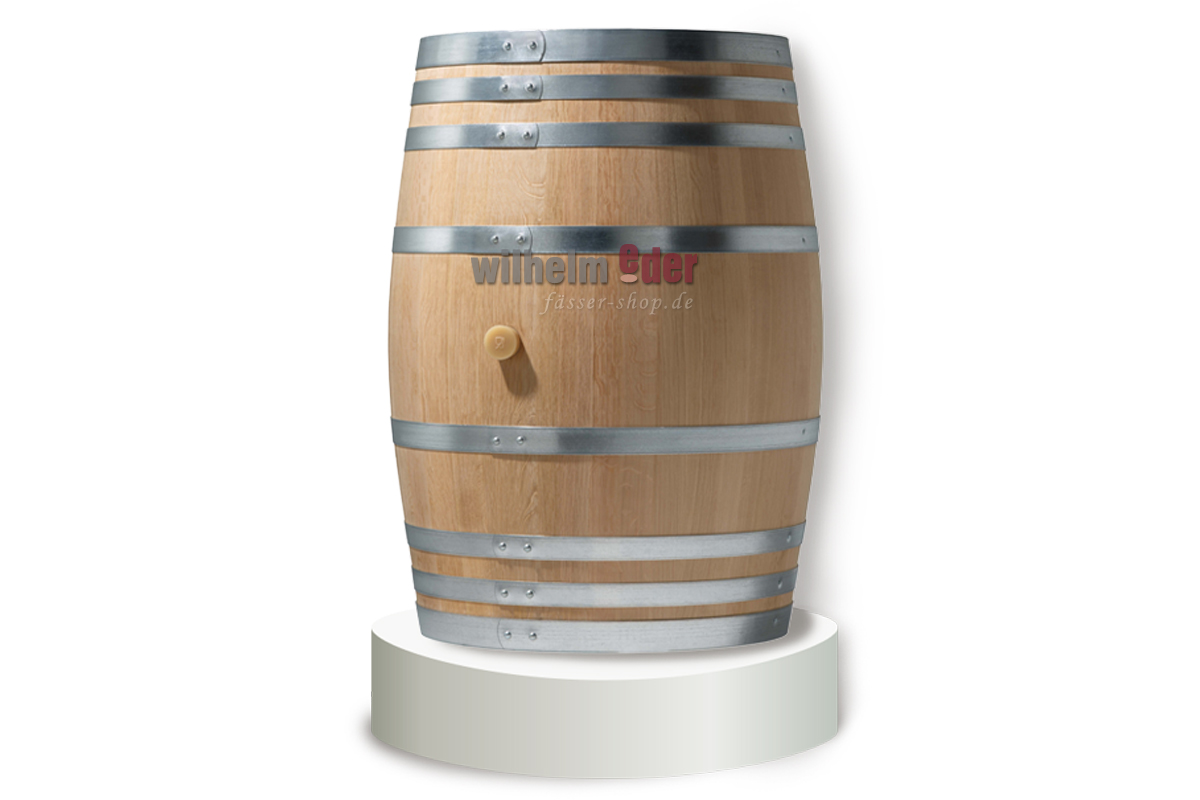
shape: Export 300, 102 cm stave lengthBarrel staves stored for 24 monthsbarrel hoops: 8 hot-dip galvanised hoopsWood origin: USA (Arkansas, Kansas, Missouri, Oklahoma)Toasting technique: Traditional with toasted headsAromas: rich oak wood and roasted aromas, vanilla, spices, brown sugarPalate: balance between fruit and roasted aromas, rich in structure and with a fine finishPerfect for: strong red and white wines such as Cabernet Sauvignon, Chardonnay, Merlot, SyrahWe recommend a maturation period of: 12-18 months
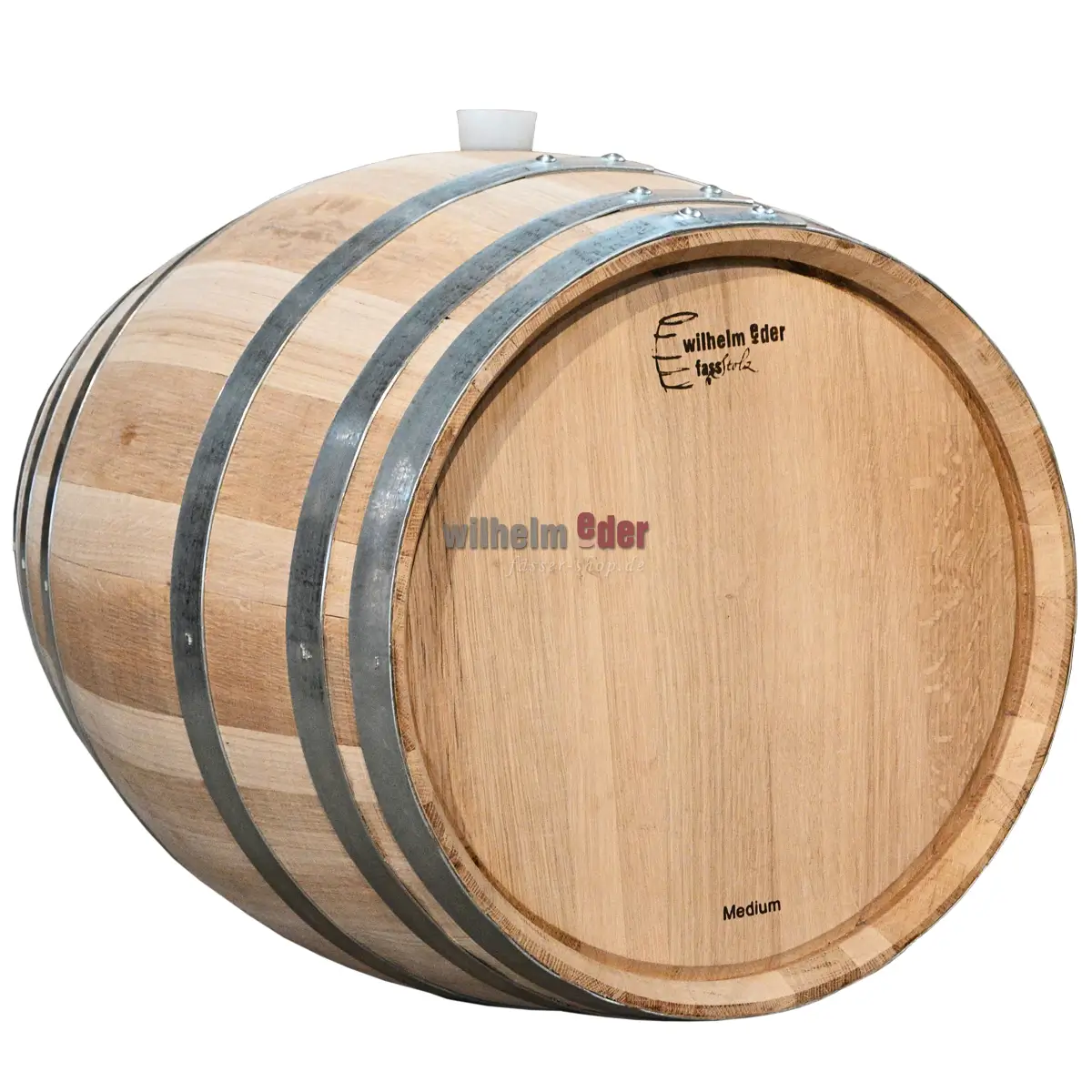
Made from seasoned oak wood, origin Palatinate Forest / Northern Vosges!Fine-grained on red sandstone grown about 200 years, sustainably logged. These barrels are manufactured in our own cooperage in Bad Dürkheim and are suitable for smaller batches of wine as well as for distillates.The standard version of these barrels is medium toasted (Fine tannic structures, toasted bread, vanilla, light caramel), but we can also toast according to your specifications. The barrel is equipped with a silicone bung as standard. Supplied without barrel storage or rack. All toastings are applied very slowly, you can see it in the uniformity inside the barrel and without burn bubbles on the stave! Our toastings are depth acting to that effect. Please note, the content indicated for wooden casks do not correspond with net capacity. The capacity can be higher or even less. Balances are not reason for reclamations.
A hybrid barrel made of American and German oak. The German oak was used for the staves and the American oak for the heads.The barrel was crafted for the producer who wants softer oak flavors with increased complexity after extended aging. Heavy Toast with a light Char finish The barrel has been toasted slowly over an oak fire for 30 minutes before it catches on fire to create the light char level on the surface. Longer aging is required for this toast to maximize flavor and complexity. The barrel is equipped with a silicone bung as standard. Supplied without barrel storage or racks. Please note, the content indicated for wooden casks do not correspond with net capacity. The capacity can be higher or even less. Balances are not reason for reclamations.
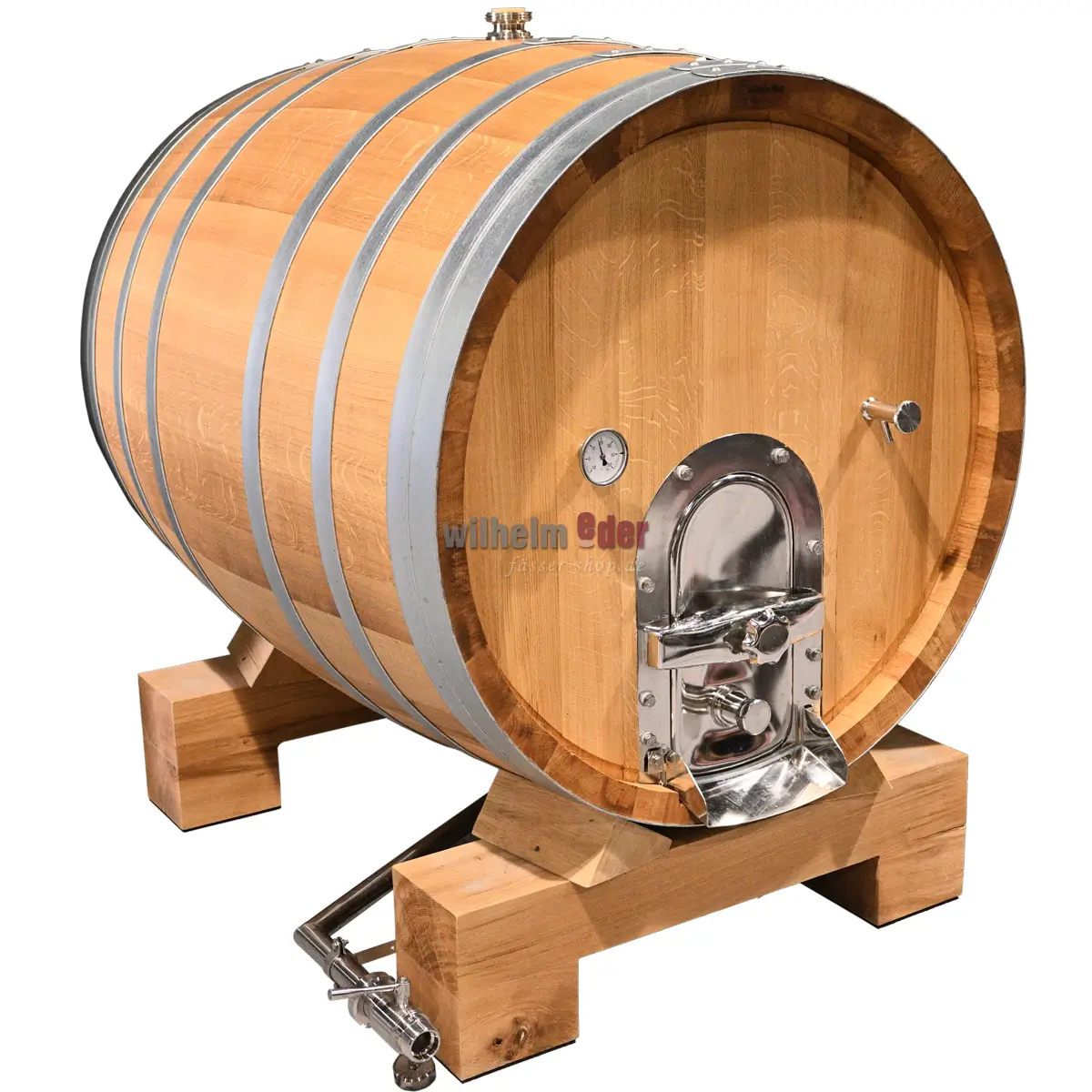
Produced from seasoned oak wood, origin Palatinate Forest / Northern Vosges!Fine-grained on red sandstone grown about 200 years, sustainably logged.Growing area: Palatinate Foresthot-dip galvanised hoopsToasting: according to customer requirementsEquipment:- Toasted inside or wine green- Wooden door with stainless steel barrel screw- Silicone bung on the bunghole - Hot dip galvanised hoops- Lacquered with colourless and breathable lacquerDimensions approx:Stave thickness: 40/45 mmStave length: 135 cmØ belly: 140 cmØ head: 110 cm Please note: the article photos show optional extras that are subject to surcharge.Delivery and assembly costs are calculated individually. Delivery time by arrangement.
These barrels were built in the characteristic cigar shape to achieve a faster and more effective maturing. The barrels are available in German (brings spice and emphasizes the fruit) or American oak (brings vanilla and increases the mouthfeel). Due to the elongated design with the same volume, the inner surface is larger than that of a 110 l barrel of the classic design. This larger surface serves both for micro-oxygenation and the release of wood aromas. Several tests and tastings have shown a more balanced, harmonious result. Due to their design, the relatively small barrel heads are, like the staves of the barrel, also treated with medium toast (Fine tannic structures, toasted bread, vanilla, light caramel). The barrel is equipped with a silicone bung as standard. Our toastings are applied very slowly, you can see it in the uniformity inside the barrel and without burn bubbles on the stave! Please note, the content indicated for wooden casks do not correspond with net capacity. The capacity can be higher or even less.Balances are not reason for reclamations.

Made from seasoned oak wood, origin Palatinate Forest / Northern Vosges!Fine-grained on red sandstone grown about 200 years, sustainably logged. Growing area: Palatinate Foresthot-dip galvanised hoopsToasting: according to customer requirementsThe fermentation vat is fitted with hot-dip galvanized steel hoops. The finishing was done with a food-safe, alcohol-resistant clear varnish.Article does not include accessories or stainless steel equipment. These can be ordered under accessories, under the article.Finishing: Lacquering with clear lacquer Sample image is equipped with (not included in the price):- Sampling valve- total discharge- Filler cap for total discharge- Ball valve- Filler cap connection with ball valve Delivery time by arrangement.
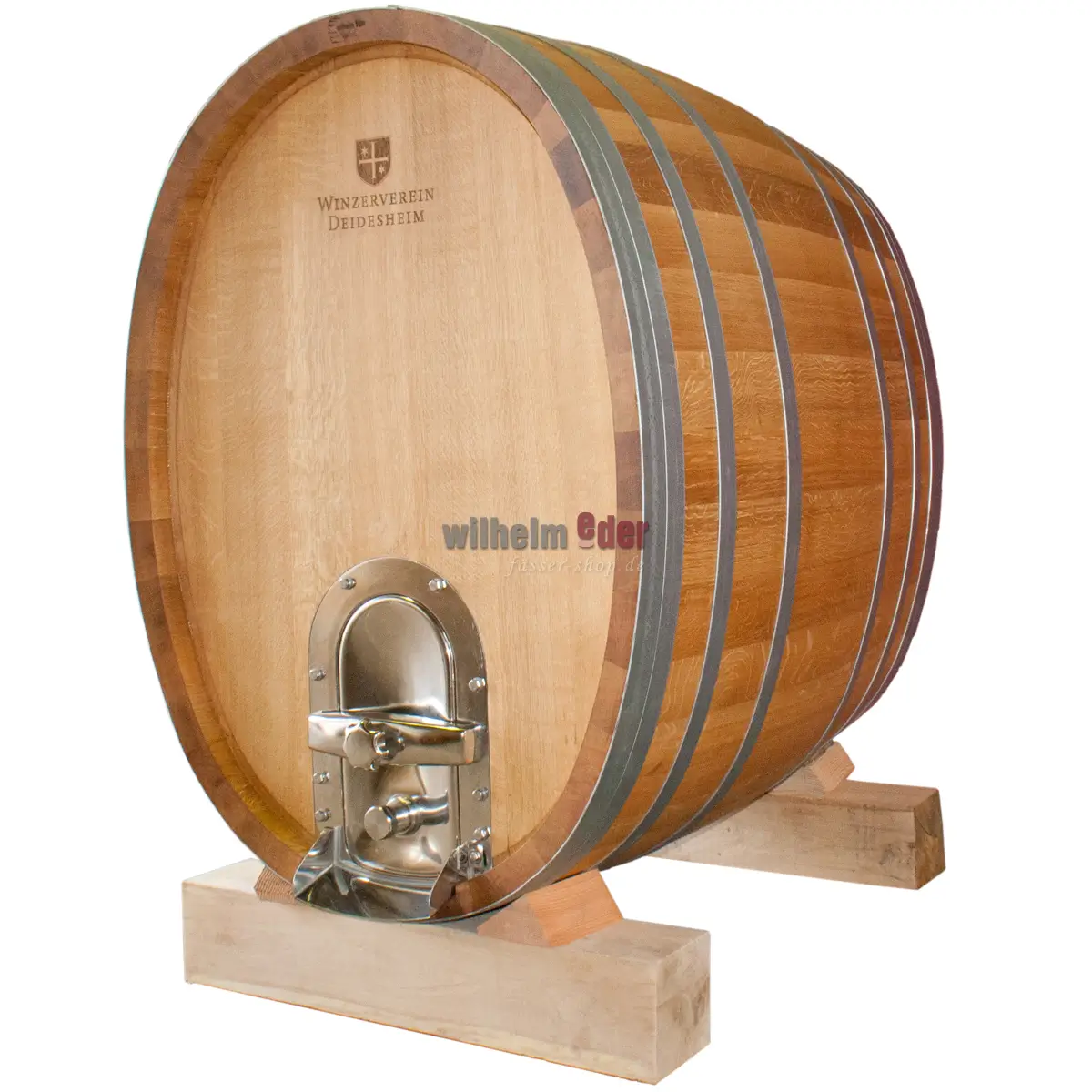
Oval wooden storage casks with a capacity of 1300 lMade from seasoned oak wood, origin Palatinate Forest / Northern Vosges!Fine-grained on red sandstone grown about 200 years, sustainably logged according to certification Naturland.Growing area: Palatinate ForestHot-dip galvanised hoopsToasting: according to customer requirementsAll casks are equipped with a bottom middle piece for possible door installation and a central stave in the belly area for possible installation of residual drains. Before delivery each barrel is checked for tightness. Fluctuations in capacity and dimensions are possible, the final calculation of the barrel is made after delivery by a water meter. The barrels are equipped with hot-dip galvanised tyres and a wooden door as standard. They are treated with linseed oil or a clear, food-certified and breathable varnish (please specify under "comments" when ordering). Please note: the photos of the articles show special equipment, which is subject to surchargeOption stainless steel hoops:Width: 60 mm and 70 mmSurcharge per cask or barrel and on request. Delivery and assembly costs are calculated individually. Delivery time by arrangement.Suitable accessories can be found below. Not found the right barrel size? Ask without obligation for a personal offer.

Oval wooden storage casks with a capacity of 1300 l. In the front of the barrel is integrated plexiglass pane. Two ideas were foremost in our minds when we decided to make the inside of your barrel visible. The barrel had to be not only high tech but also aesthetically pleasing. The result is a visually appealing and perfectly crafted barrel. The centre of the front of the barrel has been cut away and replaced with a special piece of plexiglass, giving you an amazing view of the inside of the barrel. You can decide if you wish to illuminate the barrel. The barrel is perfectly suited to both the wine and spirits sectors. The barrel will also be one of the highlights when you give your customers guided tours of your cellar! We have inserted a stainless-steel door into the glass panel so that the wooden dowels, which are normally part of the wooden centrepiece, are now visible and part of the glass panel. You will be “captivated” by this masterpiece for your cellar.Surcharge per cask or barrel and on request. Delivery and assembly costs are calculated individually. Delivery time by arrangement.Suitable accessories can be found below. Not found the right barrel size? Ask without obligation for a personal offer.

Made from seasoned oak wood, origin Palatinate Forest / Northern Vosges!Fine-grained on red sandstone grown about 200 years, sustainably logged.All barrels are equipped with a central stave in the belly area for the possible installation of residual drains. Before delivery each barrel is checked for tightness. Fluctuations in capacity and dimensions are possible. The final calculation of the barrel is done by a water meter after delivery. The barrels are equipped with hot-dip galvanized hoops and a wooden door as standard. They are treated with linseed oil or a clear, food-certified and breathable varnish (please specify under "comments" when ordering). Please note: the article photos show optional extras that are subject to surcharge. Delivery and assembly costs are calculated individually. Delivery time by arrangement.
German oak barrique 228 l with silicone bung.Made from seasoned oak wood, origin Palatinate Forest / Northern Vosges.Matured on red sandstone for approx. 200 years, sustainably harvested.We store the wood for 36 months to achieve the optimum aroma spectrum.These barrels are suitable for white and red wine as well as for fine distillatesToasting according to recommendation and intended use:Light: Gives wood structures to the wine, develops structure, makes the aroma of the fine mature wood perceptibleMedium: Fine tannin structures, toasted bread, vanilla, light caramelMedium Plus: Sweet vanilla, caramelized sugar, emphasizes the fruit of the wine, mocha aromasForte: Dark berries, coffee, caramel, coconut, smoked hamAll toastings are applied very slowly, as can be seen from the uniformity of the toastings without any burnt bubbles inside the barrel.
Barrique made of German oak 228 l with silicone bung. A barrel equipped with a double toast for full volume and power! First a Medium Plus Toast was toasted over an oak fire and then a Char IV by gas. Applied on German oak which captivates by its spice and sweetness, the toasting grant a very intensive color, high character in mouth feeling and complexity. Ideal for maturing grain, whisky and brandies. Made from seasoned oak wood, origin Palatinate Forest / Northern Vosges!Fine-grained on red sandstone grown about 200 years, sustainably logged. The wood is stored for 36 months in order to achieve the optimal aroma spectrum.
Palatinate oak
As already mentioned, European oak has finer pores than American oak. The denser pores of the wood result in less oxidation, which makes the wood aromas more subtle and subtle. This is why this wood is considered to be particularly fine. More precisely, the Palatinate oak is the sessile oak (Quercus sessilius). Palatinate oaks grow on sandstone soils in the local low mountain range, the Palatinate Forest, for around 200 years. Only particularly fine-pored and straight-grown trees are suitable for barrel making. They are carefully selected and then carefully felled. The trunk is cut in a mirror cut and the staves are left to dry for several years in the open air, where they are deliberately exposed to all weather conditions in order to maintain the characteristic tannin structures in the wood. The staves are then processed into barrels of various sizes. Barrels of 225 liters (barrique), 500 liters (tonneaux), 600 liters (half-barrel), 1000 liters (barrel) or 1200 liters (unit barrel) are particularly common for wine production. However, barrels are also made from Palatinate oak that are smaller or larger than these examples. Traditionally, the staves are pulled together over an oak fire by a cooper to form a barrel. The subsequent toasting – usually in light, medium, medium plus or forte – also takes place over the oak fire. Depending on the toasting, there are also different aromas of red fruits, caramel or roasted coffee. In general, however, the tannins are more prominent in this wood and the vanillin content plays a much smaller role.

Slavonian oak
Slavonian oak (Quercus peduncolator) is traditionally used for the construction of large barrels between 5 and 150 hl. In the Balkan region of Slavonia, the oaks literally grow in the swamp along rivers. Due to the high groundwater level in the growing areas, the water retains the tannins, which means that Slavonian oak has a more neutral taste. The wood tones can usually be found in the background during a tasting.
Mizunara oak
The Mizunara oak (Quercus Juniperus), or water oak, comes from Japan and does not have as long a tradition in barrel making as the French or American oak. This is due to the fact that barrel making has only been practiced in Japan for less than 100 years, whereas in Europe the craft of cooperage has existed for over 2000 years. The twisted growth and high water content of this oak make it very difficult to process. Only a residual moisture content of 14% is allowed for the wood to be processed into barrels. These complicating factors mean that a barrel made from Mizunara oak is around 10 times more expensive than a barrel of the same size made from American oak. Compared to the other oak species, water oak has the lowest tannin concentration. As a result, “overwooding” occurs less frequently, which makes Quercus Juniperus all the more interesting for distillates. The Mizunara oak is very intense, especially at the beginning. Finer, more delicate aromas only develop after longer storage. It has a unique sweet but also spicy flavor profile, which is due to the high lactone and vanilla content. Aromas such as spices, kara (a type of oriental incense), sandalwood, coconut and vanilla come from barrels made from this special wood. Mizunara casks are particularly popular with whisky distillers, as the whisky can benefit enormously from the long storage in the cask.

These barrels made of Japanese oak are suitable for a long storage of distillates. The Japanese oak, or Mizunara oak (Quercus Crispula), shows some peculiarities when compared to its European or American relatives: It very rarely grows straight, but almost always has a twist, which makes it very difficult for the cooper to build a barrel from this wood. The aromas that this wood gives off are very intense, especially in the beginning. The fine aromas develop only after a longer storage. But then it shows a unique sweet and spicy taste profile, which is due to the lactone ratio and the high vanilla content of the oak. Aromas that come from the Mizunara Oak are Kara (a kind of oriental incense), sandalwood and coconut. Volume: 250 l Origin of wood: Japan Barrel hoops: hot-dip galvanised Learn what is special about this barrel wood in our blog post.

The barrels from Maison Moussié combine authenticity and innovation with the utmost elegance. They are designed to protect the wine's identity and enable the pure expression of the fruit.Innovative Toasting Technology The barrels are toasted using a patented technology involving hot stones. This combustion-free process utilizes natural stones and water elements combined with heat to create uniformly toasted barrels. Electrical conductors transfer heat directly to carefully selected natural stones. This heat energy is then transferred from the stones to the barrel staves. Additionally, convection heat generates water, which is sprayed at specific intervals during the toasting process, transforming into steam and circulating hot air to increase the temperature between the toasting machine and the staves.Jade Natural jade is an option that imparts additional elegant qualities to the finished wine.Wood - Chêne Francais Selection Premium Forêts Françaises - 24 months – very fine grain. Our premium barrel is made from very fine-grained oak (1.5 to 2 mm) sourced from French forests selected for their unique properties. The oak is aged for 24 months in our own sawmill.Available Toastings:Harmony: Brings structure, aromatic freshness, purity, and length to white and light red wines.Volupté: Offers aromatic complexity with great respect for the wine. Brings volume, roundness, and length. Suitable for white wine and light red wines.Elegance: Enhances volume and length with notes of roasting and spices. Recommended for grape varieties grown in warmer climates.Complexité: Enhances the fruit of the wine both on the nose and palate. Ideal for achieving a balanced aromatic and structural result.Hoops: 6 galvanized hoopsBung made of silicone

The barrels from Maison Moussié combine authenticity and innovation with the utmost elegance. They are designed to protect the wine's identity and enable the pure expression of the fruit.Innovative Toasting Technology The barrels are toasted using a patented technology involving hot stones. This combustion-free process utilizes natural stones and water elements combined with heat to create uniformly toasted barrels. Electrical conductors transfer heat directly to carefully selected natural stones. This heat energy is then transferred from the stones to the barrel staves. Additionally, convection heat generates water, which is sprayed at specific intervals during the toasting process, transforming into steam and circulating hot air to increase the temperature between the toasting machine and the staves.Lava Lava stones were chosen for their heat absorption and transfer properties as well as their beauty and shape.Wood - Chêne Francais Selection Premium Forêts Françaises - 24 months – very fine grain. Our premium barrel is made from very fine-grained oak (1.5 to 2 mm) sourced from French forests selected for their unique properties. The oak is aged for 24 months in our own sawmill.Available Toastings:Harmony: Brings structure, aromatic freshness, purity, and length to white and light red wines.Volupté: Offers aromatic complexity with great respect for the wine. Brings volume, roundness, and length. Suitable for white wine and light red wines.Elegance: Enhances volume and length with notes of roasting and spices. Recommended for grape varieties grown in warmer climates.Complexité: Enhances the fruit of the wine both on the nose and palate. Ideal for achieving a balanced aromatic and structural result.Hoops: 6 galvanized hoopsBung made of silicone

The barrels from Maison Moussié combine authenticity and innovation with the utmost elegance. They are designed to protect the wine's identity and enable the pure expression of the fruit.Innovative Toasting Technology The barrels are toasted using a patented technology involving hot stones. This combustion-free process utilizes natural stones and water elements combined with heat to create uniformly toasted barrels. Electrical conductors transfer heat directly to carefully selected natural stones. This heat energy is then transferred from the stones to the barrel staves. Additionally, convection heat generates water, which is sprayed at specific intervals during the toasting process, transforming into steam and circulating hot air to increase the temperature between the toasting machine and the staves.Jade Natural jade is an option that imparts additional elegant qualities to the finished wine.Wood - Chêne Francais Selection Premium Forêts Françaises - 24 months – very fine grain. Our premium barrel is made from very fine-grained oak (1.5 to 2 mm) sourced from French forests selected for their unique properties. The oak is aged for 24 months in our own sawmill.Available Toastings:Harmony: Brings structure, aromatic freshness, purity, and length to white and light red wines.Volupté: Offers aromatic complexity with great respect for the wine. Brings volume, roundness, and length. Suitable for white wine and light red wines.Elegance: Enhances volume and length with notes of roasting and spices. Recommended for grape varieties grown in warmer climates.Complexité: Enhances the fruit of the wine both on the nose and palate. Ideal for achieving a balanced aromatic and structural result.Hoops: 8 galvanized hoopsBung made of silicone

The barrels from Maison Moussié combine authenticity and innovation with the utmost elegance. They are designed to protect the wine's identity and enable the pure expression of the fruit.Innovative Toasting Technology The barrels are toasted using a patented technology involving hot stones. This combustion-free process utilizes natural stones and water elements combined with heat to create uniformly toasted barrels. Electrical conductors transfer heat directly to carefully selected natural stones. This heat energy is then transferred from the stones to the barrel staves. Additionally, convection heat generates water, which is sprayed at specific intervals during the toasting process, transforming into steam and circulating hot air to increase the temperature between the toasting machine and the staves.Lava Lava stones were chosen for their heat absorption and transfer properties as well as their beauty and shape.Wood - Chêne Francais Selection Premium Forêts Françaises - 24 months – very fine grain. Our premium barrel is made from very fine-grained oak (1.5 to 2 mm) sourced from French forests selected for their unique properties. The oak is aged for 24 months in our own sawmill.Available Toastings:Harmony: Brings structure, aromatic freshness, purity, and length to white and light red wines.Volupté: Offers aromatic complexity with great respect for the wine. Brings volume, roundness, and length. Suitable for white wine and light red wines.Elegance: Enhances volume and length with notes of roasting and spices. Recommended for grape varieties grown in warmer climates.Complexité: Enhances the fruit of the wine both on the nose and palate. Ideal for achieving a balanced aromatic and structural result.Hoops: 8 galvanized hoopsBung made of silicone

The barrels from Maison Moussié combine authenticity and innovation with the utmost elegance. They are designed to protect the wine's identity and enable the pure expression of the fruit.Innovative Toasting Technology The barrels are toasted using a patented technology involving hot stones. This combustion-free process utilizes natural stones and water elements combined with heat to create uniformly toasted barrels. Electrical conductors transfer heat directly to carefully selected natural stones. This heat energy is then transferred from the stones to the barrel staves. Additionally, convection heat generates water, which is sprayed at specific intervals during the toasting process, transforming into steam and circulating hot air to increase the temperature between the toasting machine and the staves.Jade Natural jade is an option that imparts additional elegant qualities to the finished wine.Wood - Chêne Francais Selection Premium Forêts Françaises - 24 months – very fine grain. Our premium barrel is made from very fine-grained oak (1.5 to 2 mm) sourced from French forests selected for their unique properties. The oak is aged for 24 months in our own sawmill.Available Toastings:Harmony: Brings structure, aromatic freshness, purity, and length to white and light red wines.Volupté: Offers aromatic complexity with great respect for the wine. Brings volume, roundness, and length. Suitable for white wine and light red wines.Elegance: Enhances volume and length with notes of roasting and spices. Recommended for grape varieties grown in warmer climates.Complexité: Enhances the fruit of the wine both on the nose and palate. Ideal for achieving a balanced aromatic and structural result.Hoops: 8 galvanized hoopsBung made of silicone

The barrels from Maison Moussié combine authenticity and innovation with the utmost elegance. They are designed to protect the wine's identity and enable the pure expression of the fruit.Innovative Toasting Technology The barrels are toasted using a patented technology involving hot stones. This combustion-free process utilizes natural stones and water elements combined with heat to create uniformly toasted barrels. Electrical conductors transfer heat directly to carefully selected natural stones. This heat energy is then transferred from the stones to the barrel staves. Additionally, convection heat generates water, which is sprayed at specific intervals during the toasting process, transforming into steam and circulating hot air to increase the temperature between the toasting machine and the staves.Lava Lava stones were chosen for their heat absorption and transfer properties as well as their beauty and shape.Wood - Chêne Francais Selection Premium Forêts Françaises - 24 months – very fine grain. Our premium barrel is made from very fine-grained oak (1.5 to 2 mm) sourced from French forests selected for their unique properties. The oak is aged for 24 months in our own sawmill.Available Toastings:Harmony: Brings structure, aromatic freshness, purity, and length to white and light red wines.Volupté: Offers aromatic complexity with great respect for the wine. Brings volume, roundness, and length. Suitable for white wine and light red wines.Elegance: Enhances volume and length with notes of roasting and spices. Recommended for grape varieties grown in warmer climates.Complexité: Enhances the fruit of the wine both on the nose and palate. Ideal for achieving a balanced aromatic and structural result.Hoops: 8 galvanized hoopsBung made of silicone

The barrels from Maison Moussié combine authenticity and innovation with the utmost elegance. They are designed to protect the wine's identity and enable the pure expression of the fruit.Innovative Toasting Technology The barrels are toasted using a patented technology involving hot stones. This combustion-free process utilizes natural stones and water elements combined with heat to create uniformly toasted barrels. Electrical conductors transfer heat directly to carefully selected natural stones. This heat energy is then transferred from the stones to the barrel staves. Additionally, convection heat generates water, which is sprayed at specific intervals during the toasting process, transforming into steam and circulating hot air to increase the temperature between the toasting machine and the staves.Jade Natural jade is an option that imparts additional elegant qualities to the finished wine.Wood - Chêne Francais Selection Premium Forêts Françaises - 24 months – very fine grain. Our premium barrel is made from very fine-grained oak (1.5 to 2 mm) sourced from French forests selected for their unique properties. The oak is aged for 24 months in our own sawmill.Available Toastings:Harmony: Brings structure, aromatic freshness, purity, and length to white and light red wines.Volupté: Offers aromatic complexity with great respect for the wine. Brings volume, roundness, and length. Suitable for white wine and light red wines.Elegance: Enhances volume and length with notes of roasting and spices. Recommended for grape varieties grown in warmer climates.Complexité: Enhances the fruit of the wine both on the nose and palate. Ideal for achieving a balanced aromatic and structural result.Hoops: 8 galvanized hoopsBung made of silicone
The barrels from Maison Moussié combine authenticity and innovation with the utmost elegance. They are designed to protect the wine's identity and enable the pure expression of the fruit.Innovative Toasting Technology The barrels are toasted using a patented technology involving hot stones. This combustion-free process utilizes natural stones and water elements combined with heat to create uniformly toasted barrels. Electrical conductors transfer heat directly to carefully selected natural stones. This heat energy is then transferred from the stones to the barrel staves. Additionally, convection heat generates water, which is sprayed at specific intervals during the toasting process, transforming into steam and circulating hot air to increase the temperature between the toasting machine and the staves.Lava Lava stones were chosen for their heat absorption and transfer properties as well as their beauty and shape.Wood - Chêne Francais Selection Premium Forêts Françaises - 24 months – very fine grain. Our premium barrel is made from very fine-grained oak (1.5 to 2 mm) sourced from French forests selected for their unique properties. The oak is aged for 24 months in our own sawmill.Available Toastings:Harmony: Brings structure, aromatic freshness, purity, and length to white and light red wines.Volupté: Offers aromatic complexity with great respect for the wine. Brings volume, roundness, and length. Suitable for white wine and light red wines.Elegance: Enhances volume and length with notes of roasting and spices. Recommended for grape varieties grown in warmer climates.Complexité: Enhances the fruit of the wine both on the nose and palate. Ideal for achieving a balanced aromatic and structural result.Hoops: 8 galvanized hoopsBung made of silicone
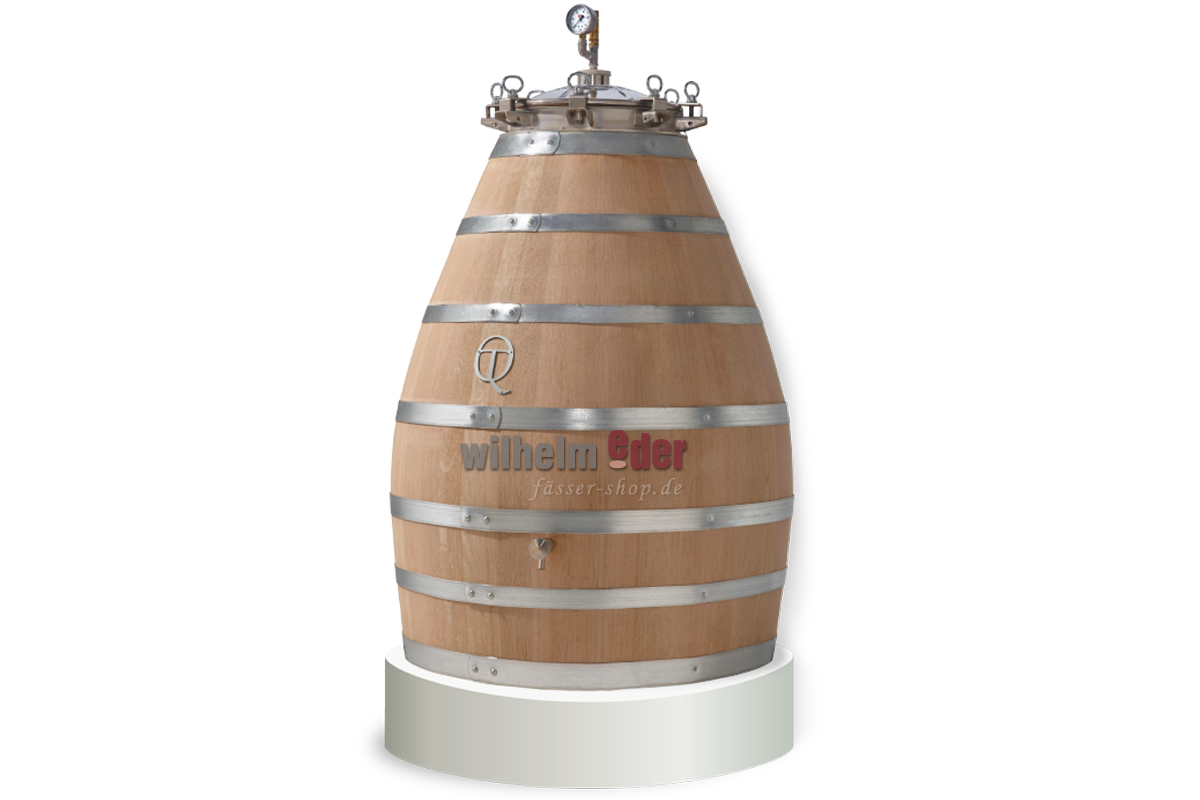
The innovation of Quintessence in the area of fermentation is the barrel „Perle de Quintessence“. It was developed for the fermentation of special wines with the cut off and oval design. The technical specifications and the unique design were carefully designed and crafted in creative collaboration with Tonnellerie Quintessence and a Grand Cru Chateau in St. Emilion. This barrel, recently presented to the public, offers an elegant touch to premium wines. The story of Perle de Quintessence started in a restaurant in St. Emilion with a sketch on a table napkin. The impulse for this barrel originated from a basic need from wineries: To get access to the content during the fermentation without altering the barrel. A prototype was built in the Tonnellerie Quintessence with traditional cooper tools and was tested in a winery. To get constant quality they tested two different vintages with respectively eight Perle de Quintessence barrels. Benefits:- Particularly developed for fermentation- Easily removable lid with an hermetic seal- If wished you can increase the gad pressure so that the pomace is pressed more towards the juice- The design warrants that the trester is gathered at the most narrow and conical part of the barrel Wood: French oak Includes:- Pressure relief valve- Sample tap- Stainless steel cover Toasting: An extended pre-toast makes the staves more flexible and facilitates the barrel's special design. After the pre-toast they use a special developed Toasting called “Perle”. It preserves the fruit and adds a hint of oak and complexity. An elegant solution for many grape varieties.
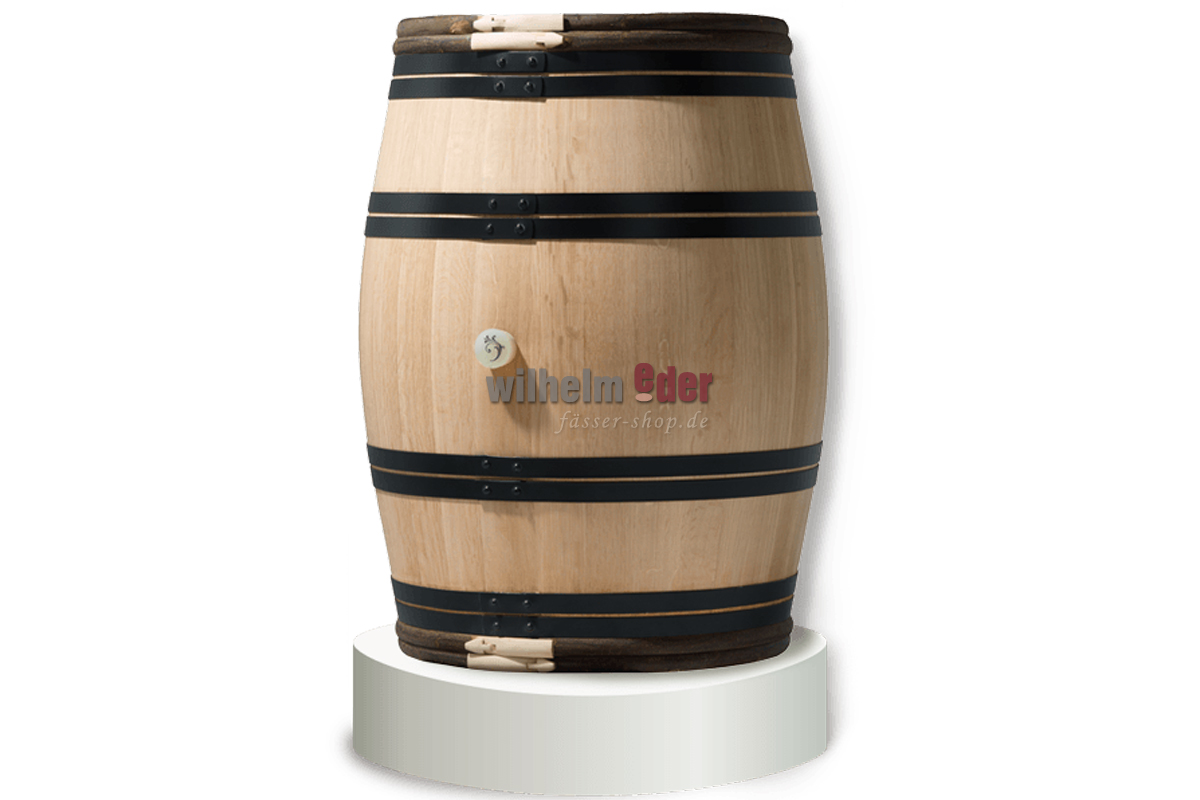
The premium barrel of the Tonnellerie Quintessence With its 4 decorative chestnut hoops, the carefully selected wood, the beautifully decorated front and the 8 black barrel hoops, this barrique is a real highlight for your wine cellar.
Limousin oak
The classic among oaks! The Limousin oak grows in large forests in central France around the city of Limoges. It is one of the most popular woods for making barrels. The rather large-pored and tannin-rich wood gives the product an expressive color and a pronounced tannin structure. In addition to wine barrels, Limousin oak is also used to make distillate barrels, for example for maturing cognac or eau de vie. French cooperages process the wood in a similar way to German cooperages. The sizes are also similar to those of barrels made from German oak. Barrique (225 l) or tonneaux (500 l) sizes are particularly common in France. French oak also has many sensory similarities to Palatinate oak. The different toastings also allow different aromas to be produced. For example, a distillate that has matured in a wooden barrel with medium toasting can have aromas of dark fruit, toasted bread and coffee. The aromas always depend on the thermal treatment of the wood, the type of distillate and the duration of storage.

Let us now turn to the special types of wood that are often used for barrels in viticulture, but also for spirits and beers. The following woods, which are mainly found in Central European forests, show – each on its own, but also in combination – an incomparable characteristic.

Barrels from mulberrywood are excellent for aging plum or other stone fruits. A very golden colour and sweet flavours are characteristics after aging. Recommended also for pomace or grappa. Mulberry wood, one high-aromatic wood combined with a high color yield during the maturation in the barrel. Originally this wood has been produced from excellent wine barrels and it presents a special freshness and a flavor of fruits for weeks during the summer. Mulberry wood is well-suited for aging of the plum distillate or some other stone fruits. It provides a deep golden-brown color and a sweet aroma during the maturation. It is also ideal for aging of Grappa. The fantastic results are meanwhile being clearly different from cider brandy of stylistic Calvados. In contrast to our other wooden aging barrels, these mulberry barrels have been lacquered with a certified, breathable clear coat which supports the tightness of the mulberry barrel, which is not at all easy due to its characteristics. This barrel hereby provides a slightly lower microoxygenation. Please note, the content indicated for wooden casks do not correspond with net capacity. The capacity can be higher or even less. Balances are not reason for reclamations.
Mulberry tree (Morus)
Mulberry, a wood that has now become very rare. The last time I found it was at a timber sale in the Swabian Alb. The wood of the white mulberry is very hard, golden yellow in color and is used for the construction of distillate barrels, nowadays up to a stave length sufficient for a 225 l barrel. Larger staves can hardly be realized due to the growth height of up to 6 m. We generally toast the barrels lightly to medium in order to apply a manageable amount of wood sugar to the inner surface of the wood. The characteristics of mulberry barrels are sweet and spicy with a very high color release. The ageing time must be adjusted. Too long storage in the barrel spoils the spirit. With shorter maturation times, the mulberry refines the distillates with a pleasant sweetness.
Robinia (false acacia, Robinia)
This interesting tree with its extraordinarily hard wood can be found in the wild in our German low mountain ranges, especially in the Swabian Alb and the Palatinate Forest. The tree has a rich, sweet scent when in bloom. The wood is yellowish in color and very hard. It is ideal for barrel making. Depending on the selected toasting level, this wood offers fresh aromas, which are particularly appreciated in white wine, or even aromas of bacon and smoked ham, which some whisky lovers like on their maturing distillate made from smoked or peated malt. When it comes to fruit brandies, we recommend acacia above all for distinctive stone fruit varieties such as plums or very aromatic apple distillates, which should deliberately differ somewhat from mainstream calvados. As already mentioned, the selection of the right toast is particularly important. Toasting is a decisive factor when it comes to successful ageing with that certain “aha” experience.
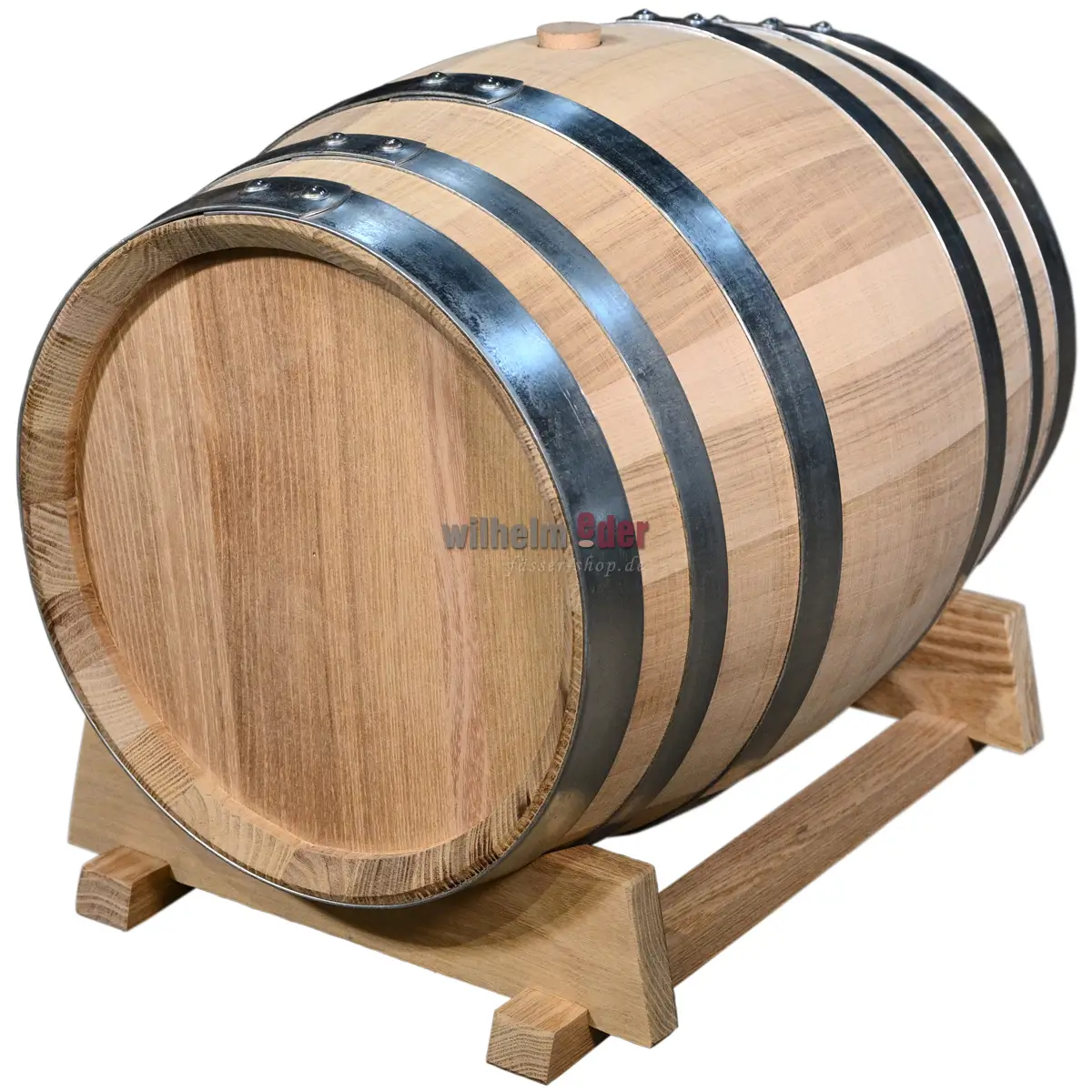
These acacia barrels are ideal for use as distillate barrels because the interior of this acacia barrel is raw – for better breathing and aging. The Robinia (acacia) offered by us as a barrel also comes from sustainable forestry from the Palatinate Forest, here from the Bürgerwald in Annweiler! The exterior of this acacia barrel has been toasted lightly. All of these barrels are equipped with galvanized hoops. The acacia barrels from small barrel series have been toasted lightly; the high toasted acacia barrels provide a strong punch with significant effects on whisky or Kornbrand etc. The acacia barrels do not color as strongly as oak barrels or mulberry barrels, they hardly give cis-lactone and therefore they are suitable for pure maturation of many fruit spirits, such as elegant grape marc spirit. Please note, the content indicated for wooden casks do not correspond with net capacity. The capacity can be higher or even less. Balances are not reason for reclamations.
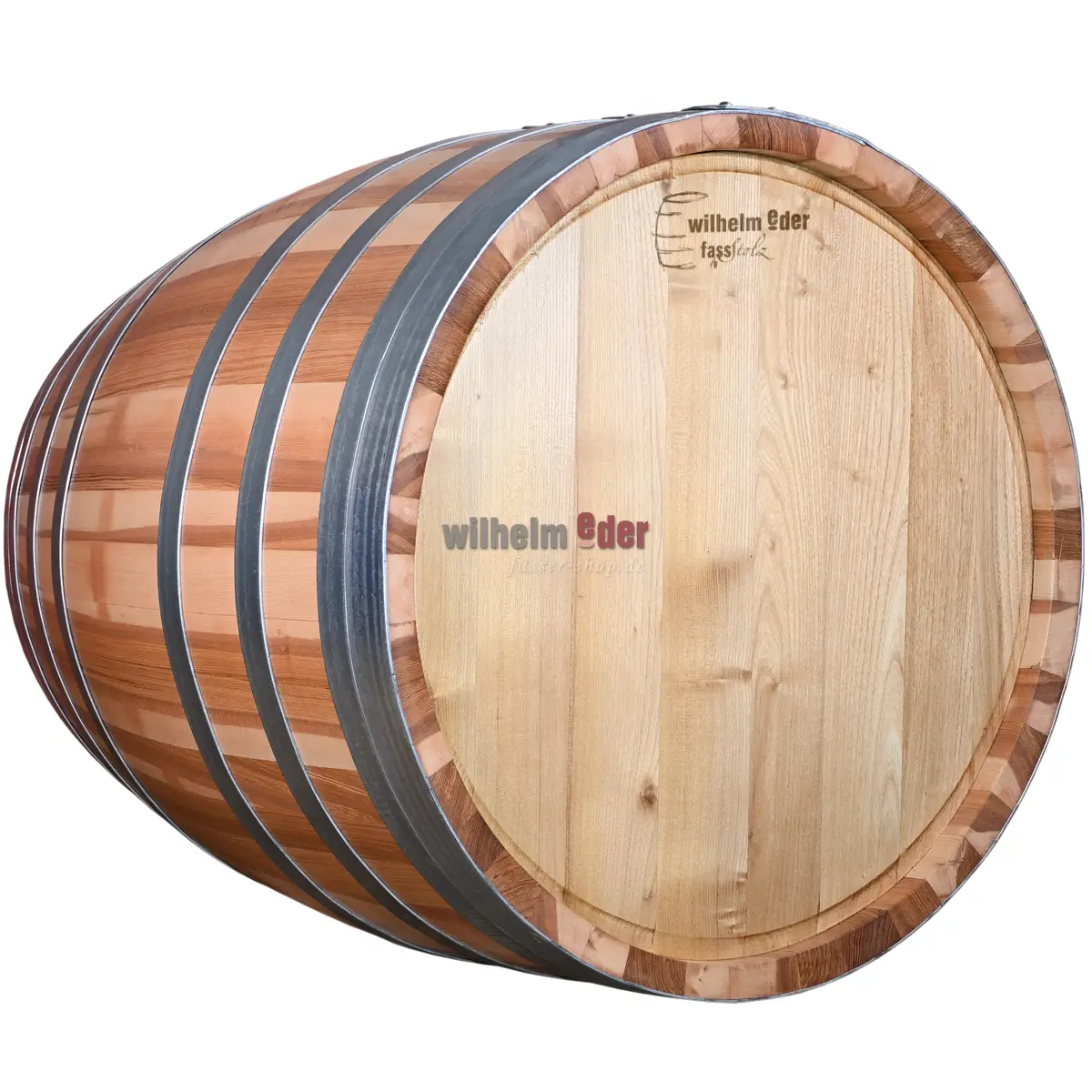
An innovation from our cooperage. A special settlement for aging fine distillates. The staves are made of ash and the barrel heads are made of acacia (robinia). The barrels were also medium toasted on the inside on the same woods by fire. All woods come from the Palatinate forest. The final treatment is a breathable varnish certified for food.Toast: Medium Equipped with hot galvanized hoops and silicone bung
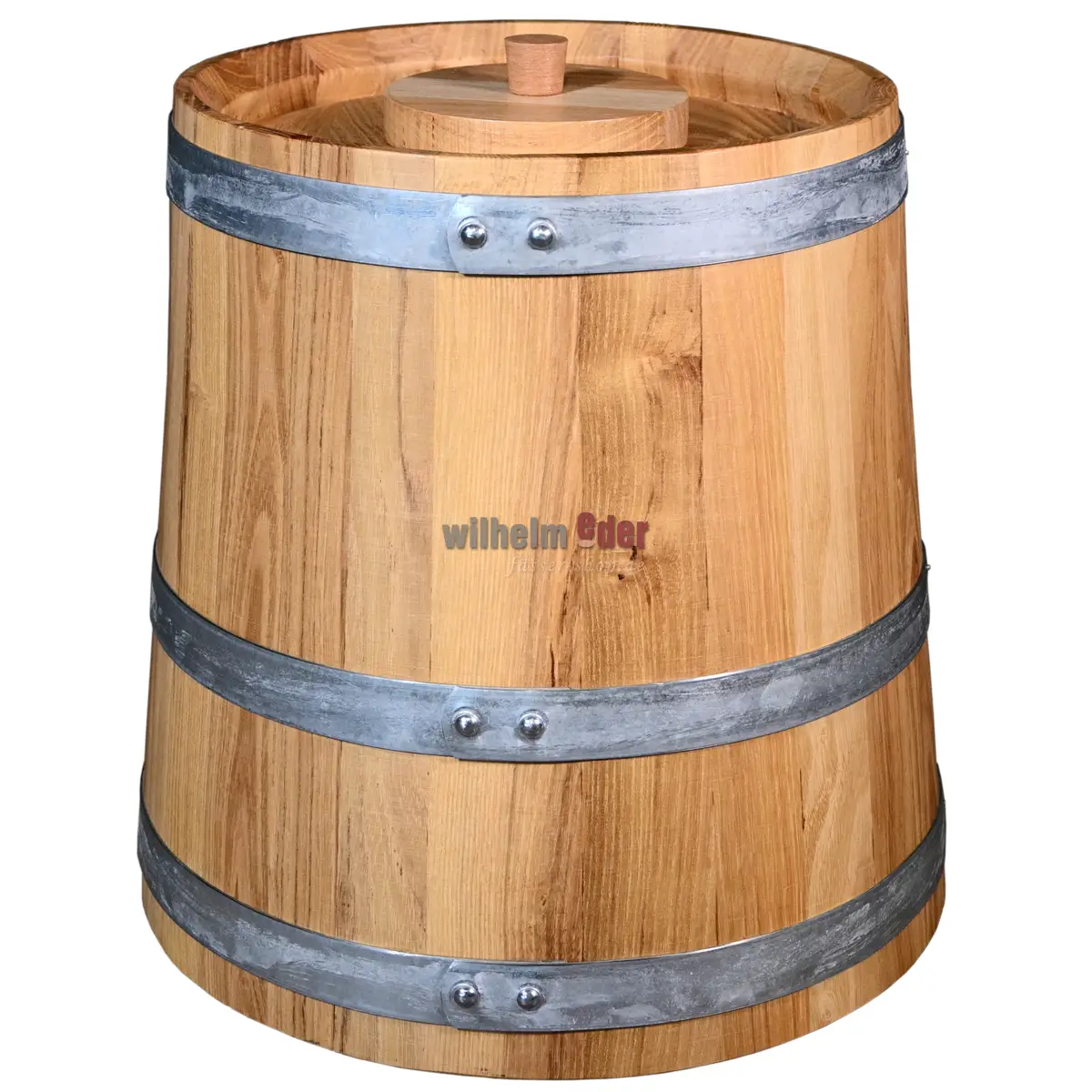
Solid acacia vat with cover.These traditionally manufactured vinegar vats made from the finest acacia / robinia are not only an eye-catcher in your production, sales or home, but also reflect a return to the original and to quality products. Acacia wood containers are not only used to store vinegar, balsamic vinegar or fermented foods, but also give them more structure and depth of flavor through the toasting of the staves used.The vinegar vats are therefore not only suitable for the maturation and aromatic refinement of high-quality vinegars and balsamic vinegars, but also enable the original fermentation of vegetables, cabbage and beans.This type of vat is also ideal for storing dry food, as is being practiced in an increasing number of “unpackaged” stores, for example.The “Back to Nature” vat is made in the cooper tradition and is bound with galvanized tyres.The barrel is lightly toasted on the inside
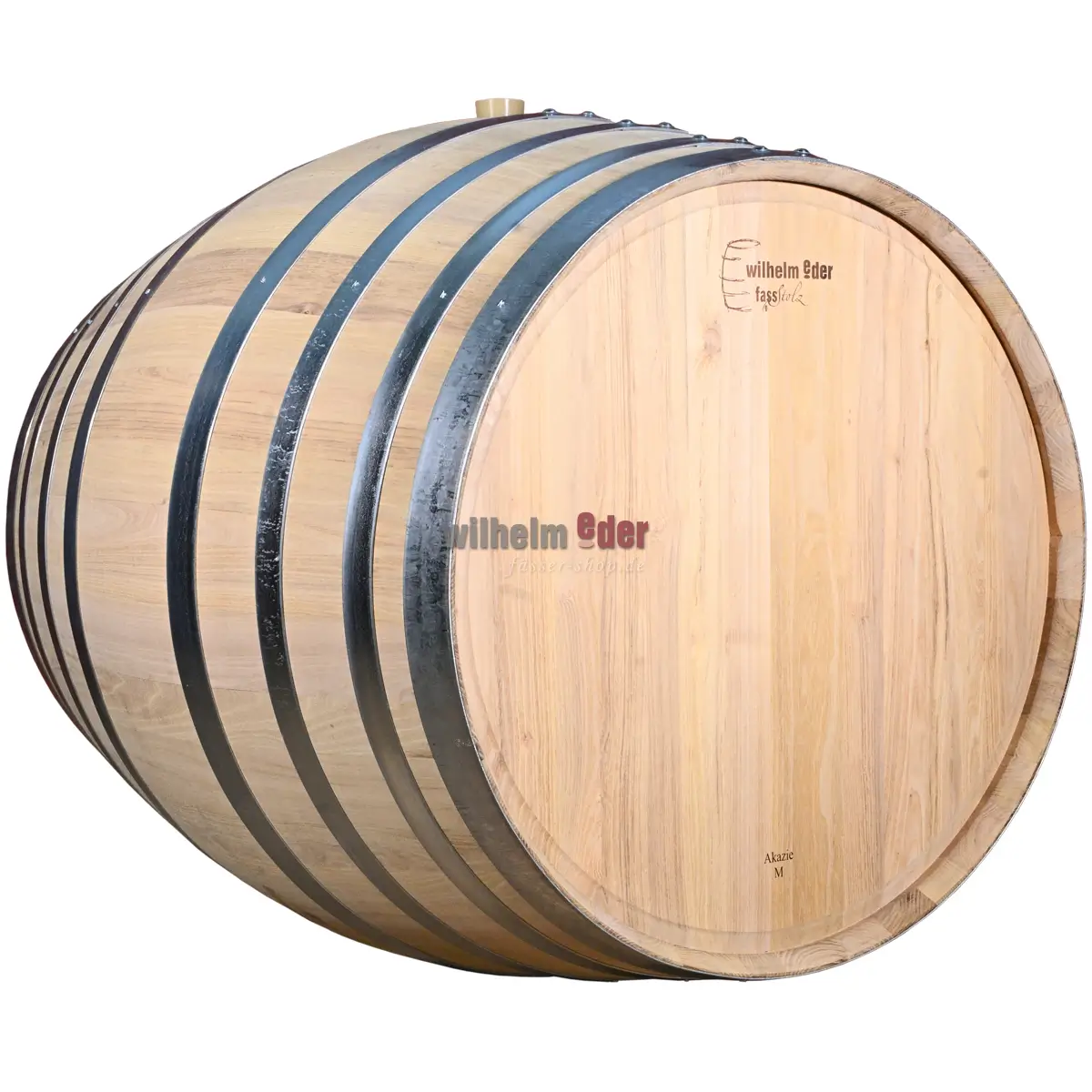
Produced from the "false acacia", the European robinia.The barrel is intended for distillates, with a strong toasting it brings strong structures of bacon and ham for the maturation of whisky or grain brandies.Lightly toasted or in the second filling, it is ideally designed for maturing a fine plum - the barrel then brings a fine sweetish flavor-enhancing note to the plum.In the wine segment, the acacia brings fine fresh notes paired with honeydew melon and herbs, e.g. for Riesling - but then only lightly toasted here too.The barrel is made of split wood. 8 hot-dip galvanized hoops.
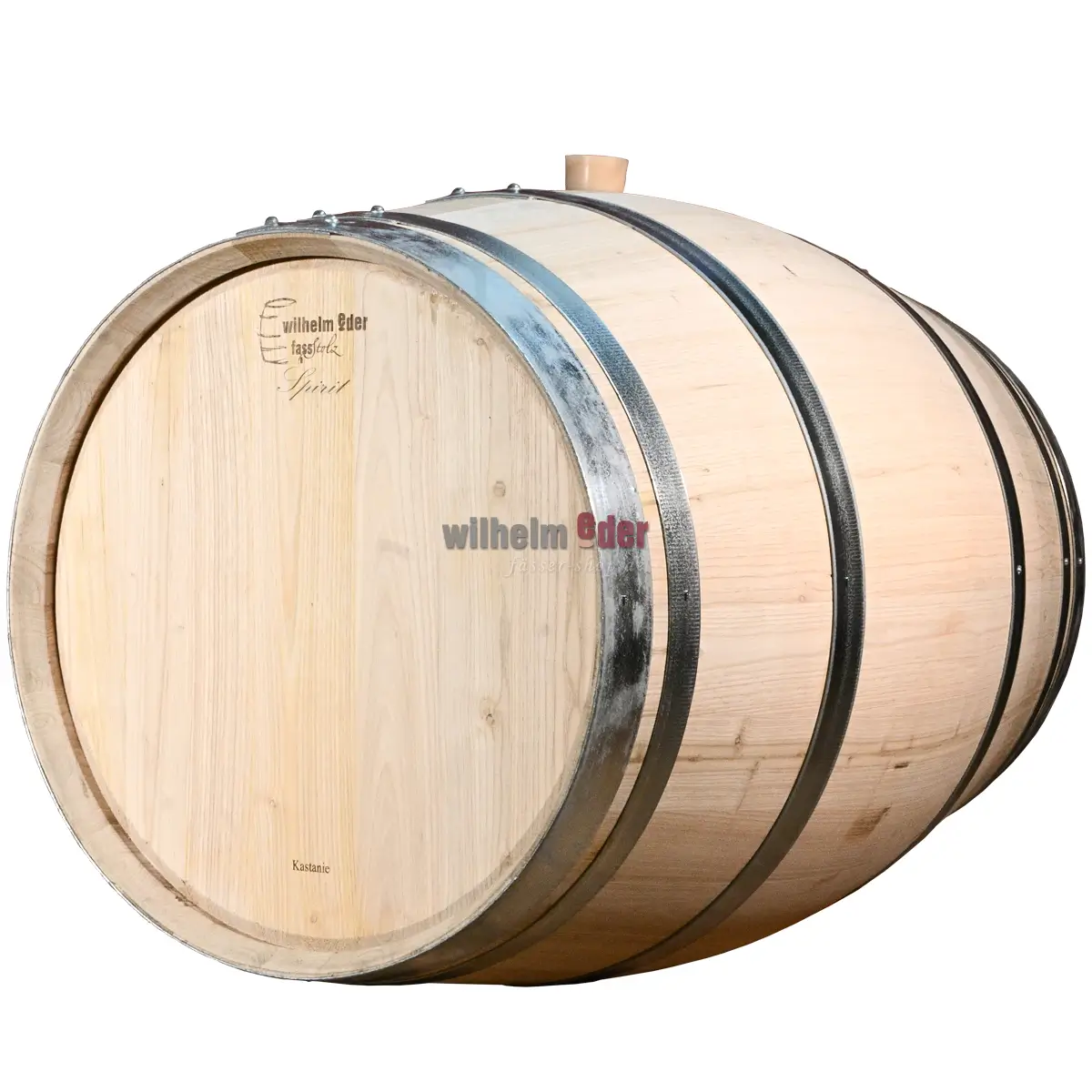
Barrique made of chestnut wood 228 l with silicone bung. One barrel equipped with a double toast for full volume and power. For high character in mouthfeel and complexity. Ideal for maturing grain, whisky and brandies. It was the Romans who probably brought us the chestnut from the Caucasus. In the meantime, the warmth-loving tree has become native to southern Germany and especially to the Palatinate Forest.Heat-loving in this context does not mean dry-loving!Our wood for our barrel series "Eder FassStolz® Kastanie" comes from one of the most beautiful and best purchasing areas in Germany for the sweet chestnut, the Wasgau region near Trifels Castle in the heart of the Palatinate Forest!Year after year with the end of the vegetation phase from October, November onwards, we select together with the foresters some of these trees, sometimes several hundred years old, under the aspect of sustainability and climate protection, in order to produce especially valuable wine and distillate barrels from them.By the way, the chestnut was the tree of the year 2018!The fruit of the trees is also used in culinary delights, whether in soup, bread or in some game dishes. Toast Spirit: Medium Plus Toast + Char 4The barrel is equipped with a silicone bung as standard.
Sweet chestnut (Castanea sativa)
Actually a very old barrel of wood, the Romans probably brought the chestnut from Asia Minor to our homeland. The Palatinate Forest in the Wasgau region is a special habitat for this tree species. The chestnut is a thermophilic tree, which may even have a future in the future forests of our homeland – but it also needs water! Chestnuts can be easily processed into barrels of all sizes and produce a woody, honey-scented aroma. Chestnut barrels give a good punch without the bitter tannins that characterize oak. In many deconstruction tastings in which chestnut casks are included in the blend, this type of wood proves to be a crowd favorite. It is particularly recommended for grain and whisky spirits, as well as for distillates with a particularly high starch content, such as a whisky with a predominantly maize component, bread distillates, etc. Chestnut can also be used in very distinctive distillates such as rowan or cherry, the latter in order to provide new approaches to maturation and flavor characterization. Here, the almond aromas go perfectly with the character of forest honey. Originally, chestnut wood was used to make large wine barrels, preferably barrels in which red wines were matured! We are currently working on a revival of chestnut and, compared to other special woods and compared to oak, already in significant quantities, even industrial customers have been convinced of the advantages of this wood!
Real walnut tree (Junglas Regia)
Whenever the opportunity arises, we buy walnut trees at the timber submissions, as we do with all other types of wood. It is a valuable wood that is often not easy to process into staves. There has recently been great demand from our customers in the distillate sector in particular, including for testing purposes in the wine and beer segment. The orders far exceed the supply of wild-grown trees that cannot be ordered. It is worth a try to use the barrels made from walnut wood for different types of fruit. Just as is done in the country richest in walnut trees, Kyrgyzstan. Here, in the shade of large wild walnut trees, numerous original orchard fruit varieties grow, which are naturally distilled and matured in barrels made of walnut.
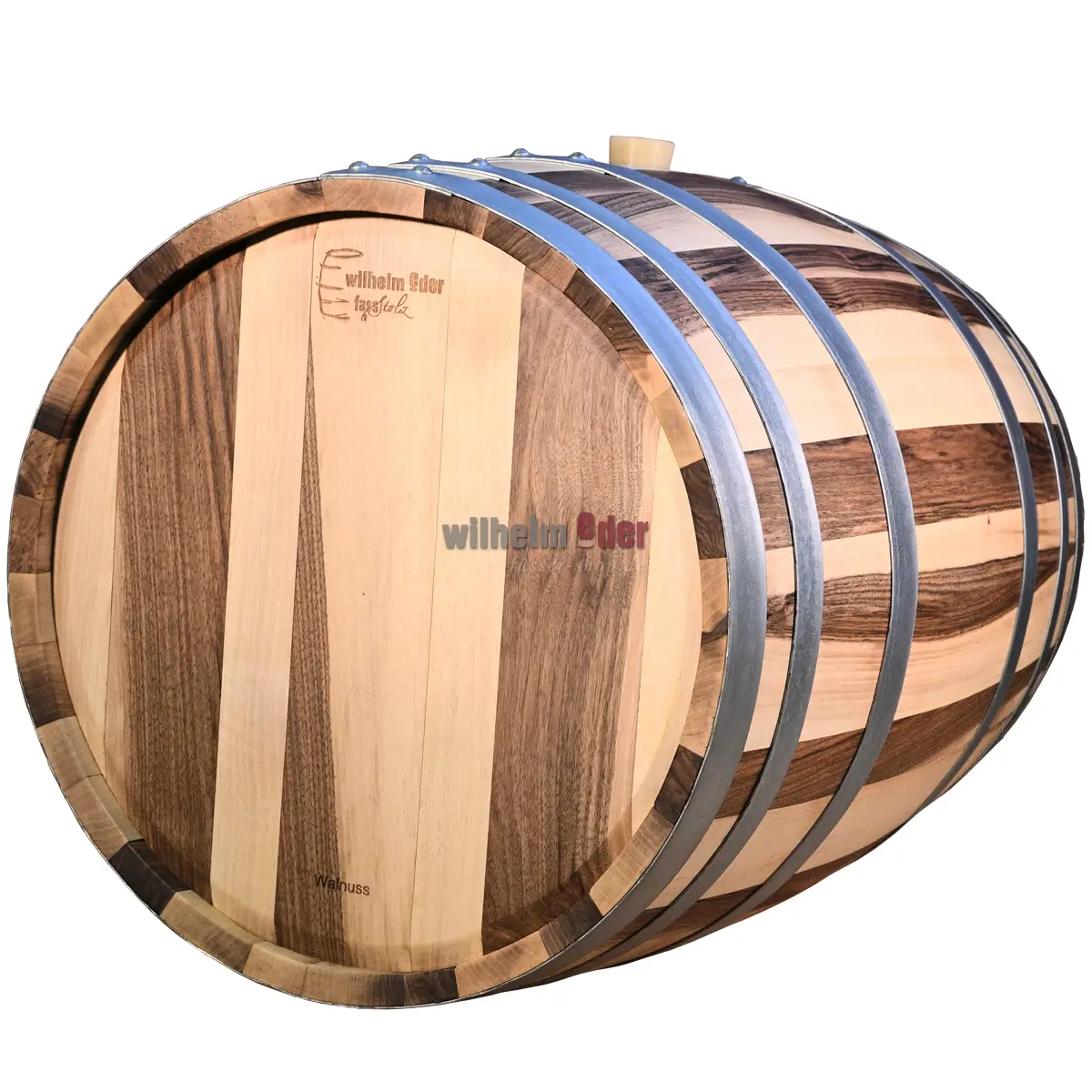
Walnut wood is rare, delivery time may varyHandmade in our cooperage in highest quality from fine-grained, air-dried walnut – highly aromatic!Toast: MediumAromatic: nougat, roasted nuts, caramelEquipped with hot-dip galvanised hoops and a silicone bung.Frequent leaks - please monitor the drum as often as necessary.We do not guarantee for tightness!
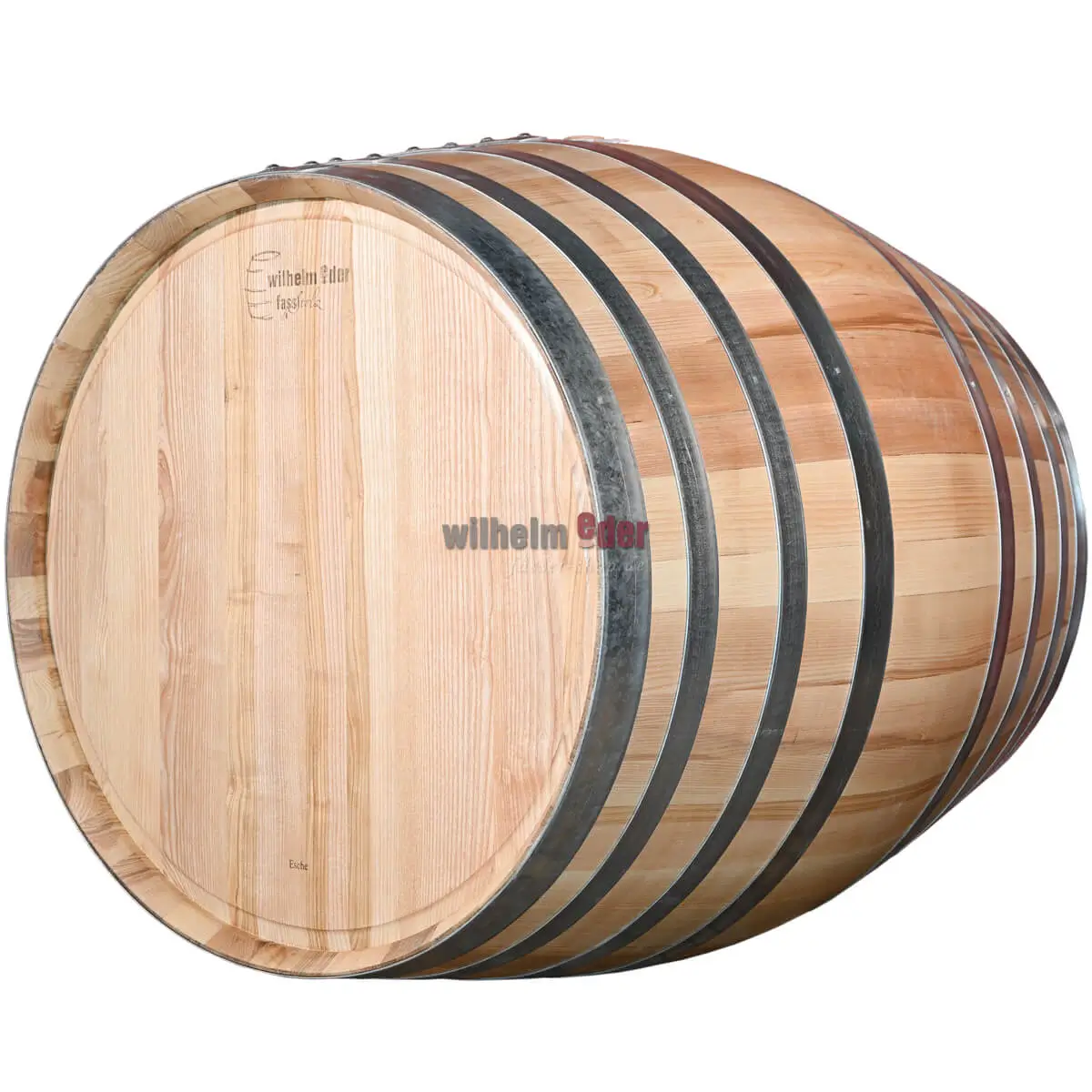
They are made from Ash wood (Fraxinus excelsior), an old wood type for barrel-making. The barrels are for aging of distillates, such as grain and fruit spirits, but without release some of its color. This wood ensures a balanced maturation through a restrained micro-oxygenation without colorants. The distillate matures in the pureness of its nature and the taste is pleasantly soft.
Common ash (Fraxinus Excelsior)
A wood that is often found in floodplain landscapes and moist stand areas. The ash is of great silvicultural importance. It is often planted to secure slopes, provided fodder in past decades and was often used to make bows, tools and sledges. In our segment, barrel making, ash was a very popular wood for softening distillates without giving them too much color or tannins and aromas. You can still find very old ash barrels in grain distilleries or fruit distilleries, for example, which are still in use, simply to give the product time to mature and marry with the air flowing in from outside. Ash has recently come back into fashion, and I’m particularly pleased about this – yes, in the small distillery segment for the delicately emerging “plant” of fruit brandies! Last but not least, I would like to introduce you to our new barrel, based on sustainability considerations.
Kiri wood
A distillate barrel, we are also experimenting with wine and beer barrels made from Kiri wood – the so-called imperial tree. Outside of the forestry law, this tree grows on plantations – similar to sugar beet or other types of fruit and is harvested after approx. 11 years as a stately tree with a diameter of approx. 500 mm. According to analytical and sensory evaluations, Paulowina Imperialis is a highly aromatic wood with a high cellulose and lignin content, which can already be surmised from the physique of the oversized leaves. Due to the high levels of lignin and hemicellulose, heat-reduced toastings, which can also be applied using electric heat and secondary heat sources (e.g. hot stones), prevent smoke aromas such as gujacol during toasting, but instead create high sugar molecules on the surface of the wooden barrel by breaking down the ingredients. As a result, wooden barrels are produced which, in contrast to barrels made from traditional types of wood and known toastings, offer high aromas in the form of sweetness and vanilla when matured with distillates, wines or beers.
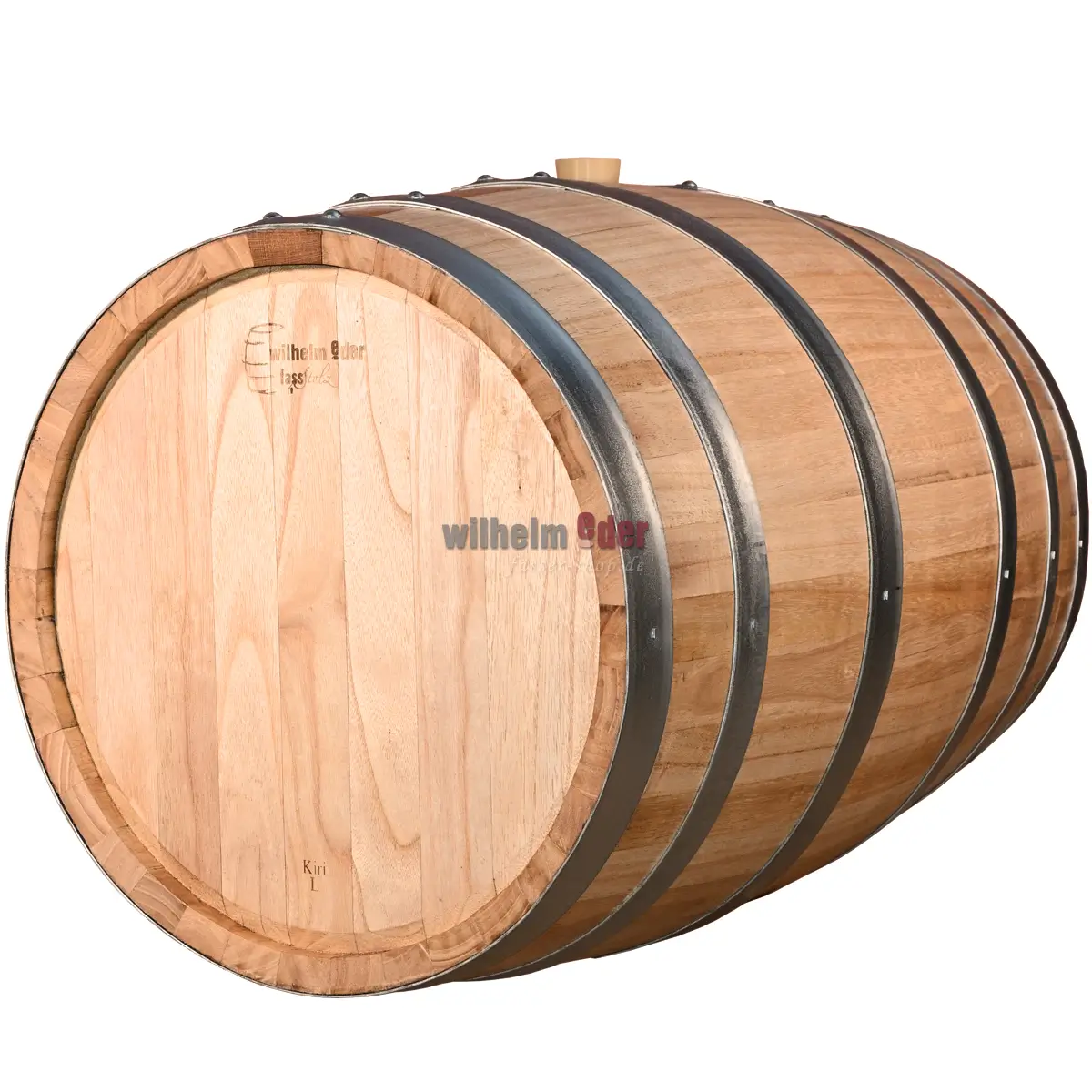
The barrel is produced out of kiri wood in our cooperage. Kiri wood is a highly aromatic wood with considerable cellulose and lignin content. Paired with heat-reduced toast, this ensures a significant splitting of the sugar molecules on the surface of the wood while at the same time preventing guaiacol smoke aromas. The result are wooden barrels that offer strong flavours in the form of sweetness, vanilla and fruit when matured with distillates, wines or beers. Our production of kiri wood barrels is another one of our innovative ideas. Widely unknown, the kiri is a cherry tree originating from Asia and is the fastest growing tree in the world. German innovation companies are now also planting this special tree under optimal growth conditions. Growing up to 5 metres per year, the kiri tree produces wood at 10 times the rate of oak. Although the production of kiri barrels is still in its very early stages, they could in the future be a complement to barrels made from more widely known woods. The wood comes from sustainable cultivation and is both air and kiln dried. Toasting: Medium Experimental barrel: Please check your barrel regularly for any leaks.
Bird cherry (Prunus Avium)
We often find this wild-growing tree in Germany’s low mountain ranges in considerable thickness and length. We can produce staves from these trunks for almost all barrel sizes up to 300 liters. Customers for these barrels, which we usually equip with a medium toast, can be found in the wine sector for Pinot Noir wines. This wood is also currently attracting a lot of attention among distillers, and new experiments are being made in the storage of gin.
Conclusion
The craft of cooperage is no longer tied to a single type of wood. Modern businesses can benefit from the sensory properties and characteristics of each individual species to create unique, competitive drinks.

Barrels made from special woods
Walnut wood is rare, delivery time may varyHandmade in our cooperage in highest quality from fine-grained, air-dried walnut – highly aromatic!Toast: MediumAromatic: nougat, roasted nuts, caramelEquipped with hot-dip galvanised hoops and a silicone bung.Frequent leaks - please monitor the drum as often as necessary.We do not guarantee for tightness!
The barrel is produced out of kiri wood in our cooperage. Kiri wood is a highly aromatic wood with considerable cellulose and lignin content. Paired with heat-reduced toast, this ensures a significant splitting of the sugar molecules on the surface of the wood while at the same time preventing guaiacol smoke aromas. The result are wooden barrels that offer strong flavours in the form of sweetness, vanilla and fruit when matured with distillates, wines or beers. Our production of kiri wood barrels is another one of our innovative ideas. Widely unknown, the kiri is a cherry tree originating from Asia and is the fastest growing tree in the world. German innovation companies are now also planting this special tree under optimal growth conditions. Growing up to 5 metres per year, the kiri tree produces wood at 10 times the rate of oak. Although the production of kiri barrels is still in its very early stages, they could in the future be a complement to barrels made from more widely known woods. The wood comes from sustainable cultivation and is both air and kiln dried. Toasting: Medium Hoops: hot dip galvanised Dimensions approx.: Volume Stave lenght Ø Head Ø Belly 30 l 50 cm 30 cm 38 cm 50 l 62 cm 34 cm 41 cm 112 l 76 cm 43 cm 53 cm 228 l 88 - 95 cm 56 cm 70 cm The barrel is equipped with a silicone bung as standard. Experimental barrel: Please check your barrel regularly for any leaks.
The barrel is produced out of kiri wood in our cooperage.Kiri wood is a highly aromatic wood with considerable cellulose and lignin content.Paired with heat-reduced toast, this ensures a significant splitting of the sugar molecules on the surface of the wood while at the same time preventing guaiacol smoke aromas.The result are wooden barrels that offer strong flavours in the form of sweetness, vanilla and fruit when matured with distillates, wines or beers.Our production of kiri wood barrels is another one of our innovative ideas. Widely unknown, the kiri is a cherry tree originating from Asia and is the fastest growing tree in the world. German innovation companies are now also planting this special tree under optimal growth conditions. Growing up to 5 metres per year, the kiri tree produces wood at 10 times the rate of oak. Although the production of kiri barrels is still in its very early stages, they could in the future be a complement to barrels made from more widely known woods.The wood comes from sustainable cultivation and is both air and kiln dried.Toasting: MediumHoops: hot dip galvanisedThe barrel is equipped with a silicone bung as standard.Experimental barrel: Please check your barrel regularly for any leaks.
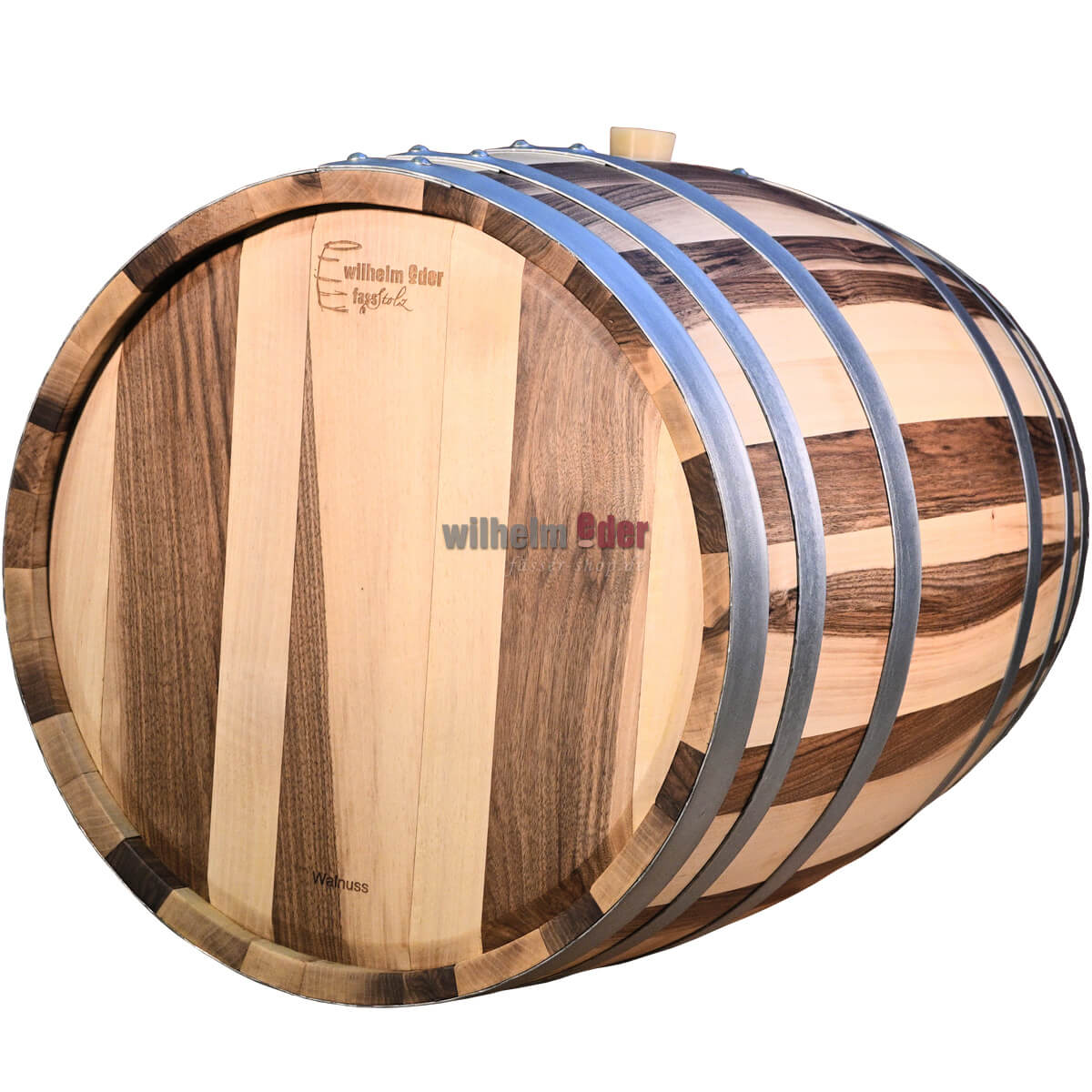
Walnut wood is rare, delivery time may vary Handmade in our cooperage in highest quality from fine-grained, air-dried walnut – highly aromatic! Toast: Medium Equipped with hot-dip galvanised hoops Aromatic: nougat, roasted nuts, caramel Frequent leaks - please monitor the drum as often as necessary We do not guarantee for tightness!
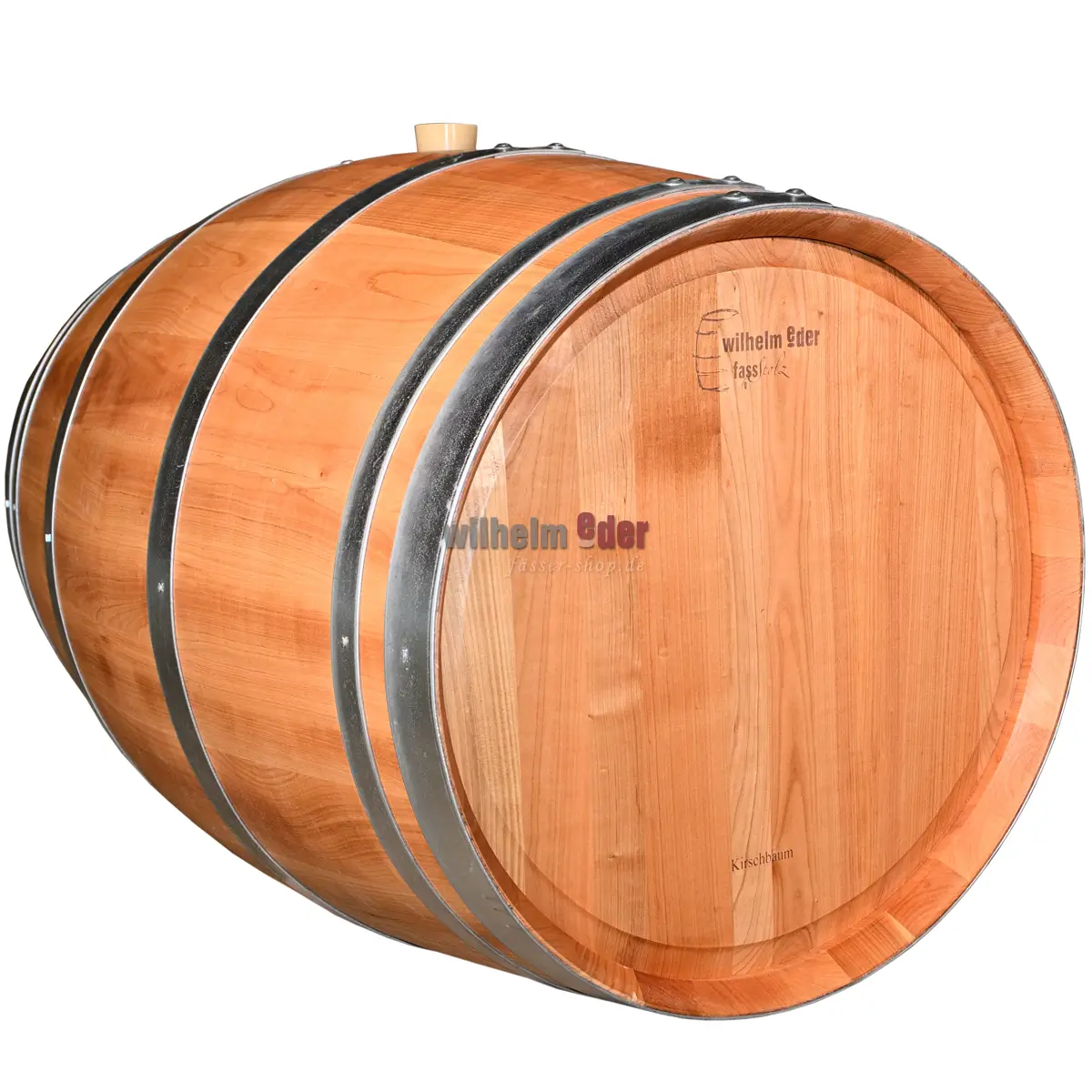
Made from wild cherry tree trunks of the bird cherry Prunus Avium. The barrels are fitted with hot-dip galvanized hoops, lightly toasted on the inside. Cherry is still the distiller’s most favorable taste. And that not only because of the fruit’s fertility but also because it is an inherent part of the culinary culture of Southern Germany and Switzerland. Since 150 years, the particular climatic conditions there and the soil conditions that the cherry trees need to enforce the fruit’s most aromatic evolvement have been and are still appreciated. The sweet cherry has not for nothing been named tree of the year 2010. It is a stone fruit and belongs to the rose family. The “kirsch” is characterized by its complex taste that takes long at its end as well as the decent and subtle flavor. Initiates describe the favor during tastings often as fleshy, fruity, chocolate, sourly aromatic, juicy, lusty or nuttily aromatic. The most crucial point for the distillers is, however, also the question if “stonetone”, i. e. an almond or marchpane flavor is desired. The question if this flavor or homogenous kirsch with a discrete fruit nature should be pursued is highly discussed. Thankfully one should say. Cause: As is generally known, tastes are different. Note: Cherry wood in the area of distillate is not always easy to process, this requires the growth forms of the cherry tree.To support the tightness, we paint the small cherry wooden barrels just like our large barrels with a breathable, water-soluble lacquer, which meets all certification requirements in the food industry and barrel construction! Please note, the content indicated for wooden casks do not correspond with net capacity. The capacity can be higher or even less. Balances are not reason for reclamations.
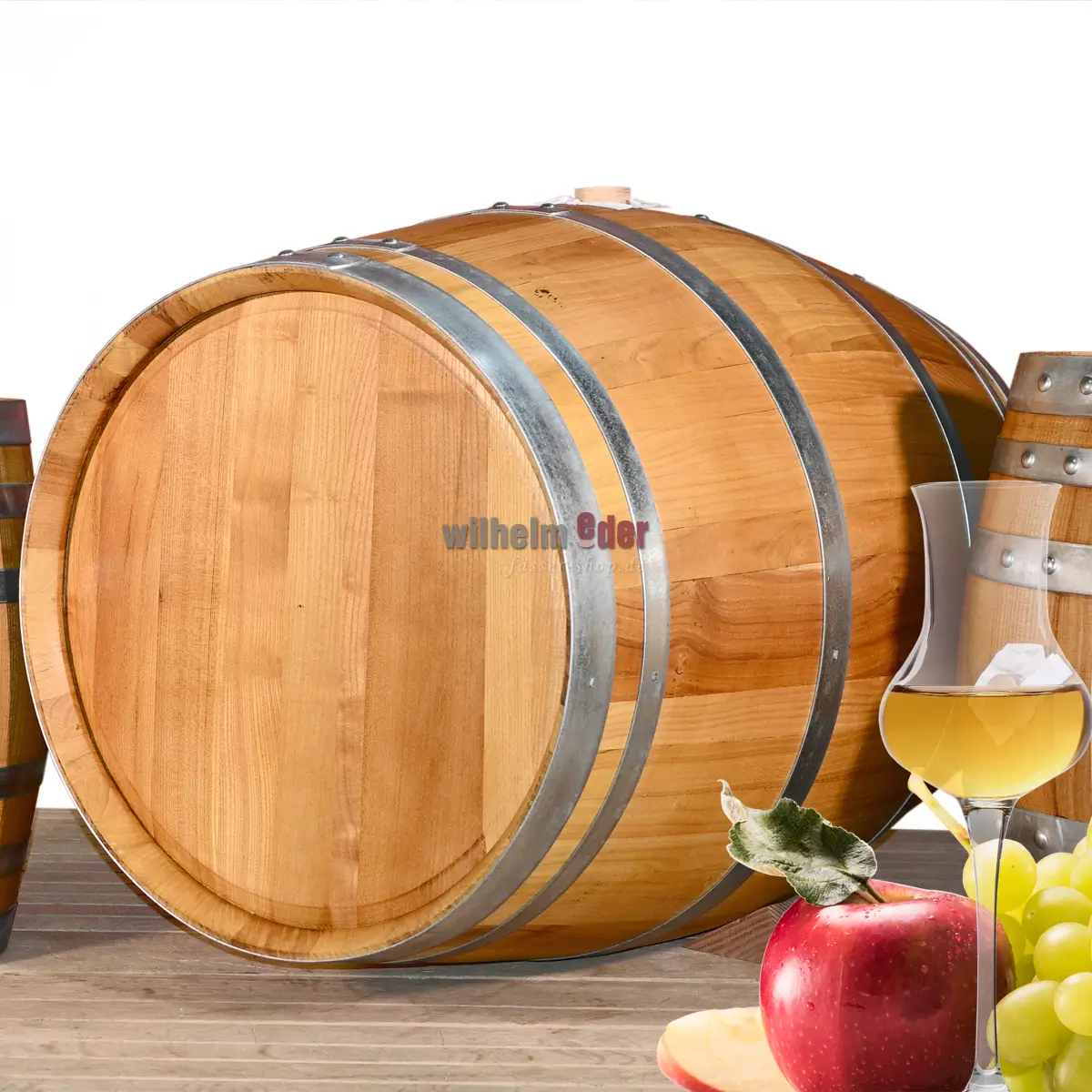
Barrels from mulberrywood are excellent for aging plum or other stone fruits. A very golden colour and sweet flavours are characteristics after aging. Recommended also for pomace or grappa.Mulberry wood, one high-aromatic wood combined with a high color yield during the maturation in the barrel. Originally this wood has been produced from excellent wine barrels and it presents a special freshness and a flavor of fruits for weeks during the summer. Mulberry wood is well-suited for aging of the plum distillate or some other stone fruits. It provides a deep golden-brown color and a sweet aroma during the maturation. It is also ideal for aging of Grappa. The fantastic results are meanwhile being clearly different from cider brandy of stylistic Calvados.In contrast to our other wooden aging barrels, these mulberry barrels have been lacquered with a certified, breathable clear coat which supports the tightness of the mulberry barrel, which is not at all easy due to its characteristics. This barrel hereby provides a slightly lower microoxygenation.The barrels up to 20 l are equipped as standard with a rack. Please select under accessories if you wish to order a rack, as well as a wooden or stainless steel spigot.Please note, the content indicated for wooden casks do not correspond with net capacity. The capacity can be higher or even less. Balances are not reason for reclamations.
These barrels made of Japanese oak are suitable for a long storage of distillates. The Japanese oak, or Mizunara oak (Quercus Crispula), shows some peculiarities when compared to its European or American relatives: It very rarely grows straight, but almost always has a twist, which makes it very difficult for the cooper to build a barrel from this wood. The aromas that this wood gives off are very intense, especially in the beginning. The fine aromas develop only after a longer storage. But then it shows a unique sweet and spicy taste profile, which is due to the lactone ratio and the high vanilla content of the oak. Aromas that come from the Mizunara Oak are Kara (a kind of oriental incense), sandalwood and coconut. Volume: 250 l Origin of wood: Japan Barrel hoops: hot-dip galvanised Learn what is special about this barrel wood in our blog post.
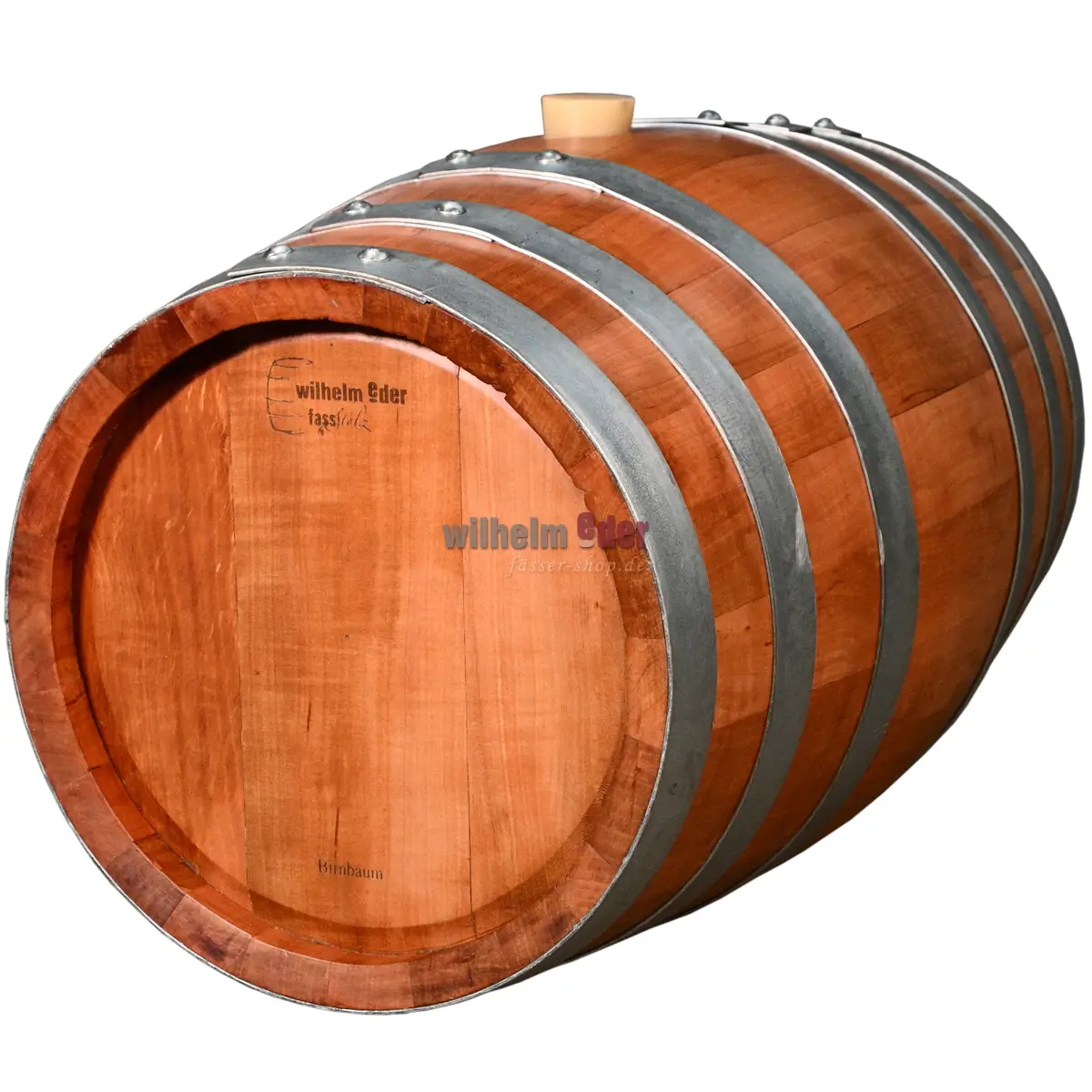
A real specialty for your distillates! These barrels were made in our cooperage from wild pear tree trunks Pyrus pyraster.The barrels are fitted with hot-dip galvanized hoops and are lightly toasted on the inside. Note:Pear wood in the distillate sector is not always easy to work with, due to the way the pear tree grows.To support the tightness, we varnish the small pear tree barrels, just like our large barrels, with a breathable, water-based soluble varnish that meets all certification requirements in the food industry and in barrel construction.Please note that the nominal size of wooden barrels does not always correspond to the net content, which may be higher or lower. Deviations do not constitute grounds for complaint.
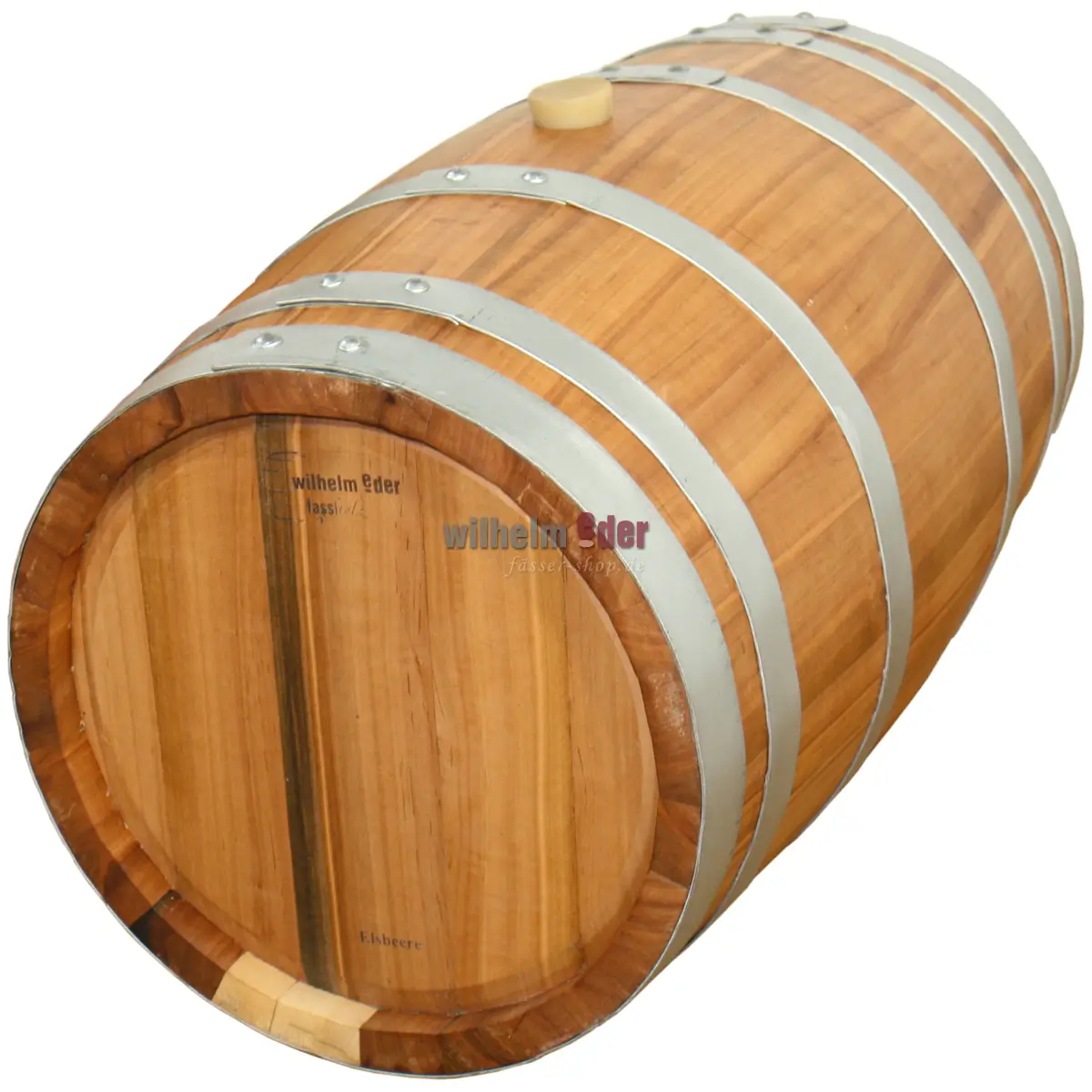
A barrel made in our cooperage under our own brand EDER - FassStolz®. The barrel consists exclusively of the air-dried deciduous wood of the Elsbeere (Sorbus torminalis). The special distillate barrel is equipped with hot-dip galvanised hoops, treated with a breathable, food-certified glaze on the outside and lightly toasted on the inside.Origin: Germany from certified forestryThe Elsbeere, among other things also "beautiful Else" called, is a rare deciduous tree species. It is one of the most expensive deciduous trees and provides a very high-quality wood of light white-yellowish to slightly reddish colour. Wild Service Berry wood is heavy, hard and tough and has comparable properties to oak.The delivery does not include barrel storage or rack.
